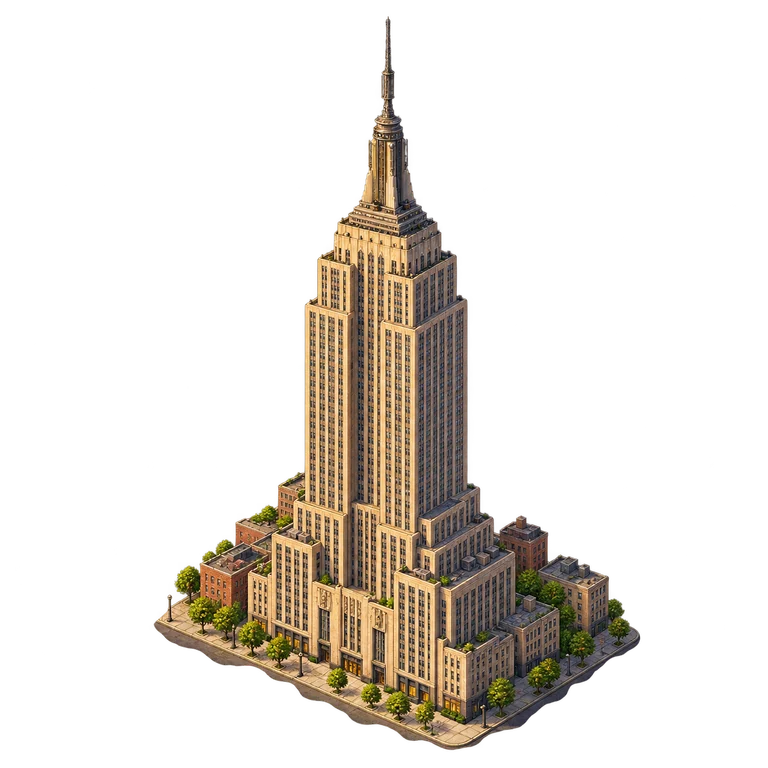
The Empire State Building opened in 1931 after an exceptionally rapid construction programme. Designed by Shreve, Lamb & Harmon and built by Starrett Brothers & Eken, the 102-storey tower combined a steel frame with a distinctive sequence of setbacks and a slender summit. Its height made it a defining feature of New York’s skyline, while films and other popular imagery carried that silhouette around the world.
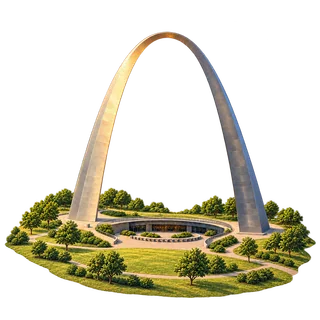
Architect Eero Saarinen designed the Gateway Arch as a landmark for St Louis. Completed in 1965, its stainless-steel exterior forms an inverted catenary, with triangular-section legs narrowing towards the top. The Arch is as wide at ground level as it is tall: 630 feet, or about 192 metres. The national park also interprets the complex history of westward expansion, including the conquest and displacement experienced by Indigenous peoples.
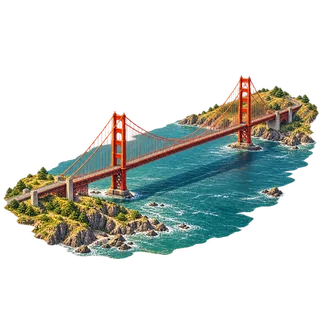
The Golden Gate Bridge crosses the strait between San Francisco and Marin County. Its name comes from the Golden Gate waterway rather than its paint. Two main towers carry curving main cables, with vertical suspenders holding the roadway. When it opened in 1937, the 1,280-metre main span was the longest suspension-bridge span in the world.
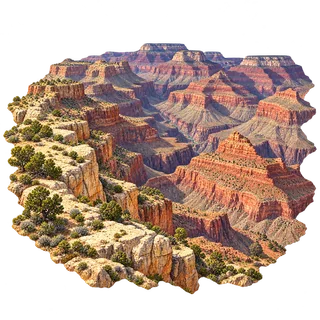
Grand Canyon cuts into the high Colorado Plateau in northern Arizona. Its walls expose successive rock units, while the inner gorge reveals much older basement rocks. The Colorado River deepened the main channel; tributaries, weathering and rock falls helped open its branching side canyons. The result is a landscape whose rock record reaches far further back in time than the canyon itself.
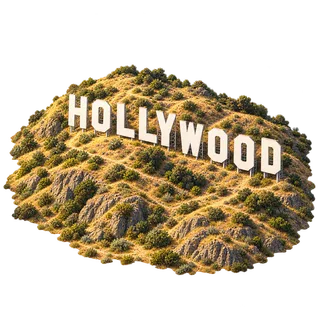
The original Hollywoodland sign was erected in 1923 to advertise a real-estate development in the hills above Los Angeles. It outlasted that short promotional role and became associated with the film industry and the city. The landmark was rebuilt in 1978. Today, the shorter HOLLYWOOD lettering stands on Mount Lee, maintained by the Hollywood Sign Trust.
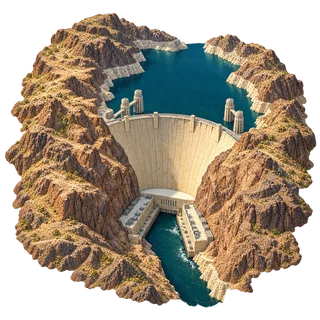
Hoover Dam was built in the 1930s across Black Canyon on the Colorado River, between Nevada and Arizona. Dedicated in 1935, the arch-gravity structure forms Lake Mead and supports water storage, flood control and hydroelectric generation. Four intake towers, arranged in pairs upstream, route water towards the powerplant and outlet systems. Below the dam, powerhouse wings follow the narrow canyon.
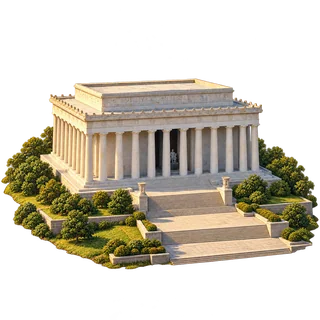
Dedicated in 1922, the Lincoln Memorial stands at the western end of Washington’s National Mall. Henry Bacon designed the building in the form of a Doric temple, while Daniel Chester French designed the seated Lincoln sculpture. The memorial’s meaning extends beyond its architecture: Marian Anderson performed here in 1939, and Martin Luther King Jr. delivered his “I Have a Dream” speech during the 1963 March on Washington.
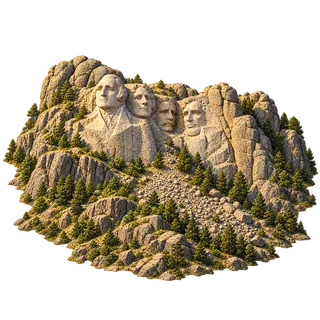
Workers carved the faces of George Washington, Thomas Jefferson, Theodore Roosevelt and Abraham Lincoln into granite at Mount Rushmore between 1927 and 1941. The sculpture is also part of a contested landscape. The Black Hills hold enduring cultural and spiritual importance for Native nations, and the project disregarded the mountain’s existing significance. Reading the place means considering both the carving and the history of the land around it.
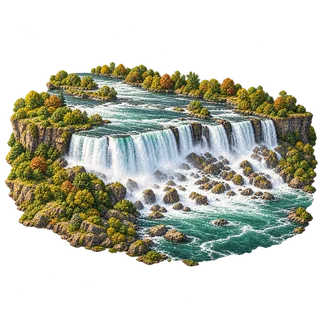
Niagara Falls is a group of waterfalls on the Niagara River in the border region shared by the United States and Canada. This discovery focuses on American Falls on the US side, rather than presenting all of Niagara as an American site. The smaller Bridal Veil Falls lies beside it, separated by Luna Island. At the foot of American Falls, fallen rock forms a broad talus slope beneath the descending water.
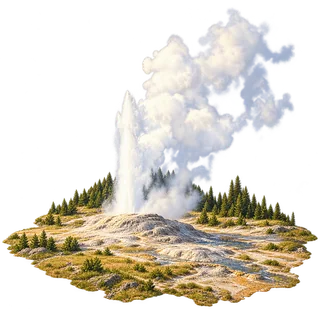
Old Faithful is one of Yellowstone’s best-known geysers. Water supplied by rain and snow seeps underground, where heat and a constricted natural plumbing system create the conditions for eruptions. Park staff study the relationship between eruption duration and the following interval to make predictions. The name does not mean a perfectly fixed timetable: the intervals change, and the geyser is neither Yellowstone’s largest nor its most regular.
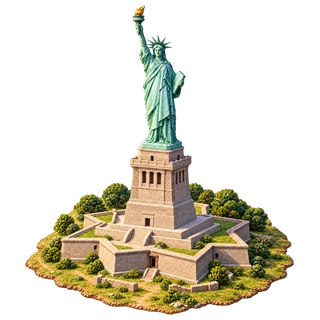
The Statue of Liberty stands on Liberty Island in New York Harbor. Designed by sculptor Frédéric-Auguste Bartholdi with engineering by Eiffel and Company, it was made in France, dismantled for its Atlantic journey and reassembled on an American-built pedestal. Its dedication took place on 28 October 1886. The copper exterior developed its green colour through oxidation. A torch represents enlightenment, while broken shackles at the figure's feet refer to the abolition of slavery. The monument also commemorates friendship between France and the United States.
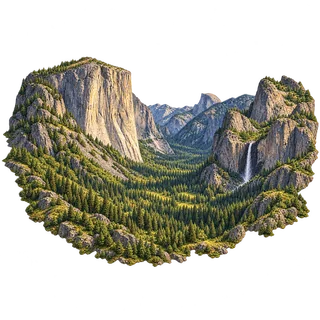
From Tunnel View, the valley opens between El Capitan on the left and Cathedral Rocks and Bridalveil Fall on the right, with Half Dome in the distance. Rivers first cut into the rising Sierra Nevada; later glaciers widened and deepened the valley into its broad U-shaped form. Granite walls now rise above a forested floor, while streams descend from hanging valleys as waterfalls.