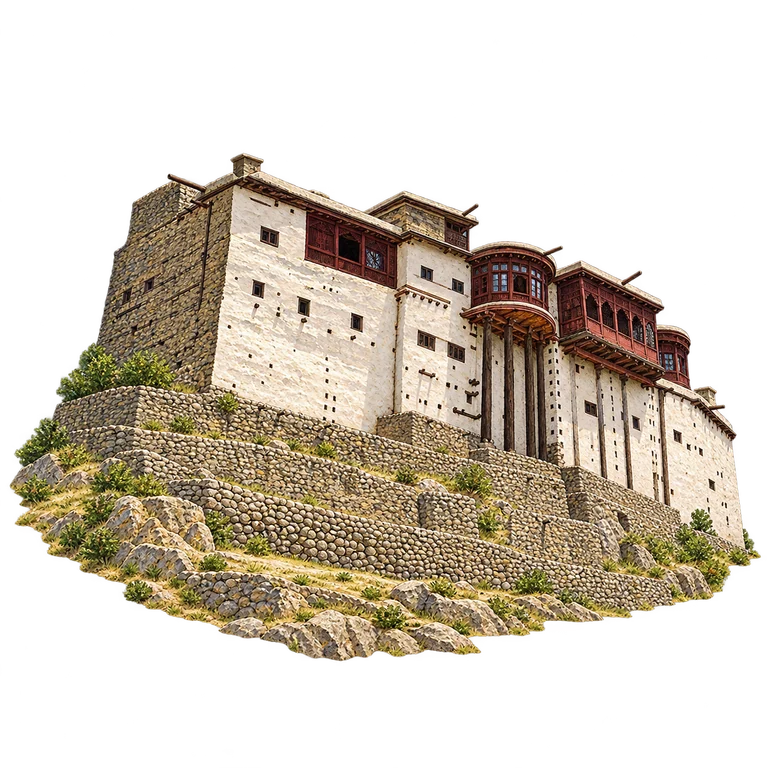
Baltit Fort stands above Karimabad in the Hunza Valley. Its thick pale walls and projecting timber galleries show how different materials can work together on a steep hillside. The Aga Khan Historic Cities Programme restored the fort as part of a wider conservation effort in Hunza and Baltistan. The building is a reminder that conservation can connect a landmark with the settlement around it. Look for the rounded wooden balcony projecting from the front, then follow the stone terraces below.
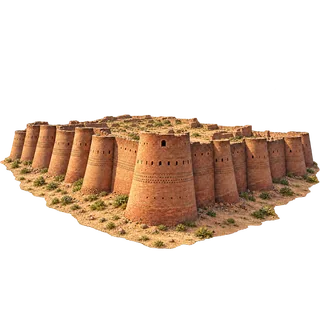
Derawar Fort is one of the surviving fortified places of the Cholistan desert. Pakistan’s heritage nomination describes a wider network of forts connected with caravan, trading and pilgrimage routes. At Derawar, tall rounded bastions make the outer walls especially distinctive. Bands of patterned brickwork run around their battered sides. The surviving fort has changed through repair and occupation, so its walls tell a longer story than any single building campaign. Look for the rhythm of curved towers against the flat desert.
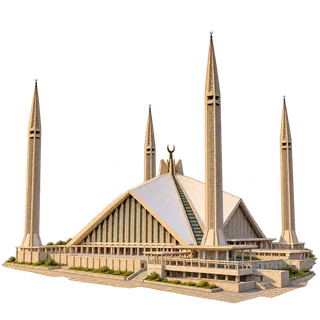
Faisal Mosque stands beside the Margalla Hills in Islamabad. Its prayer hall has an angular, tent-like roof rather than a large rounded dome. Four slim minarets rise around it, making a striking contrast with the low terraces below. The International Islamic University’s Dawah Academy is based at the Faisal Masjid Islamic Centre, where religious teaching and mosque activities continue. Look for the repeated triangular shapes in the roof and the open space between the minarets.
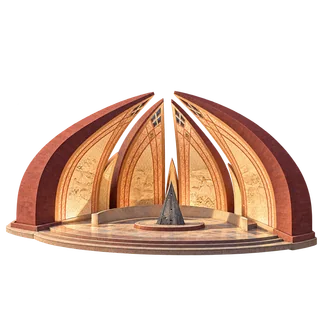
Pakistan Monument rises on Shakarparian in Islamabad. Its flower-like form brings sweeping stone petals together around a central space. Carved surfaces add detail to the inside faces, while the open gaps let the sky become part of the outline. Nearby, the Pakistan Monument Museum presents the country’s history and cultural heritage. From a distance, the broad petal shapes are the easiest feature to recognise; up close, the monument invites a slower look at its surfaces.
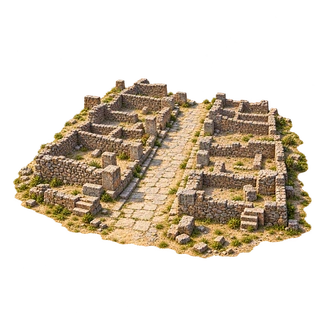
Taxila's archaeological sites record changing urban settlements and Buddhist religious life. Sirkap is one of its fortified cities, alongside other settlements and monastic remains. Influences from Persia, the Greek world and Central Asia contributed to this important regional centre of learning and exchange.