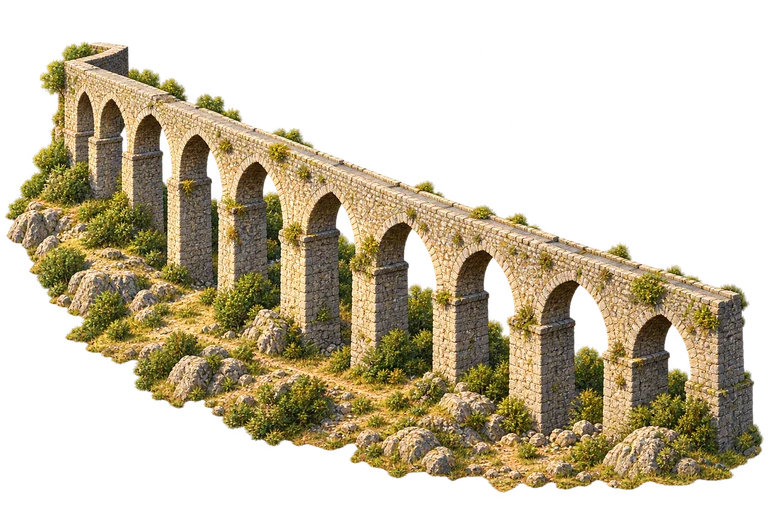
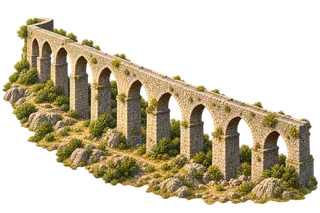
The aqueduct north of Old Bar solves a practical problem with a long rhythm of arches. Built during Ottoman rule in the seventeenth century, it carried water from a spring several kilometres away. The Tourism Organisation of Bar describes seventeen arches with different spans, supported by substantial stone piers. Look at the changing openings: the structure responds to uneven ground while keeping the water route above it.
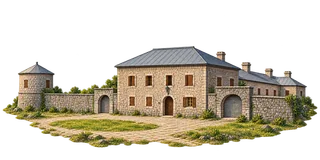
Biljarda was built in 1838 as the residence of Petar II Petrović Njegoš. Its name recalls the billiard table that became a memorable feature of the building. Today it is part of the National Museum of Montenegro, preserving objects, books and manuscripts connected with Njegoš. The simple main building, enclosing walls and round towers offer a different image of authority from a richly ornamented royal palace.
Kotor was an important artistic and commercial centre during the Middle Ages. Its traditions included masonry and icon painting, expressed within a town containing Romanesque churches and defensive walls. The 1979 earthquake seriously damaged many monuments, and subsequent restoration forms another chapter in this harbour landscape's history.
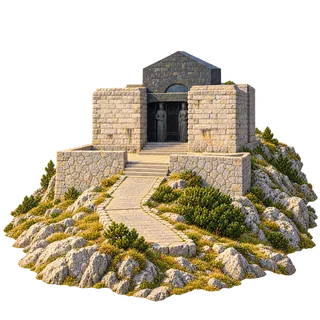
On Jezerski Vrh, the mausoleum of Petar II Petrović Njegoš brings literature, state history and sculpture together. Njegoš was a poet and prince-bishop of Montenegro. The mausoleum opened in 1974, with sculptural work and design associated with Ivan Meštrović. Two large female guardian figures flank the entrance. The ascent and high mountain setting are part of the visit, but the small entrance group rewards a closer look at its stone forms.
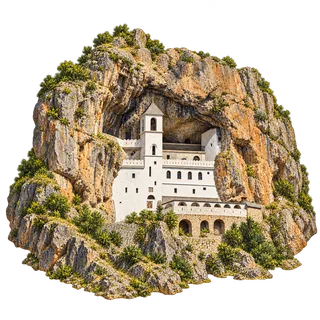
At Upper Ostrog, the cliff is part of the architecture’s setting. White walls and a bell tower stand against the rock, while cave churches connect the monastery with the mountain itself. The monastery developed in the seventeenth century and is closely associated with Saint Basil of Ostrog. It remains a place of pilgrimage. Its compact buildings and dramatic rock recess distinguish this upper complex from the lower monastery below.