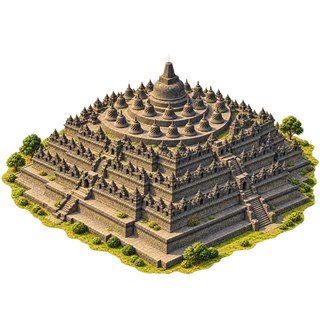
Built in central Java in the eighth and ninth centuries, Borobudur combines square terraces with circular upper platforms. Relief-covered walls and perforated stupas organise the monument's spaces. Its stepped form makes movement through the Buddhist temple part of a carefully designed architectural composition.
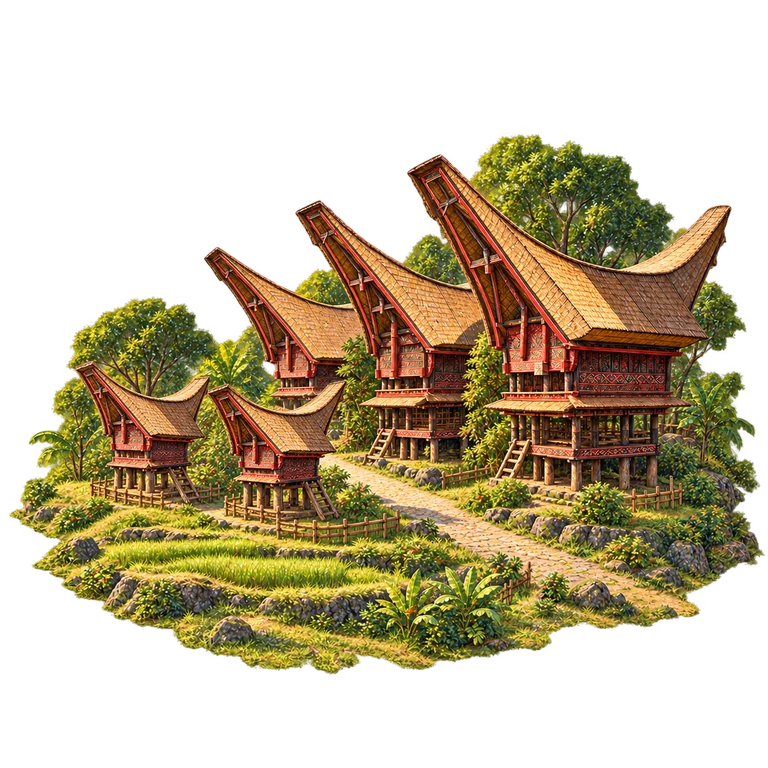
Ke’te’ Kesu’ in North Toraja is known for rows of tongkonan houses and associated rice granaries. Raised timber construction and strongly curved roofs distinguish the ensemble, while carved surfaces express a rich local craft tradition. The smaller granaries and larger houses have related forms but different functions. This scene focuses on architecture and the space between the rows, without staging ceremonies or turning the community’s burial traditions into spectacle.
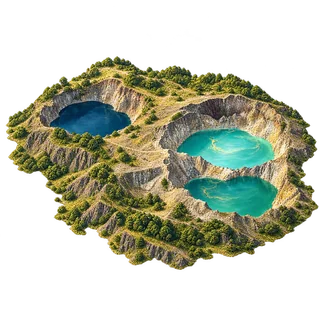
Kelimutu on Flores holds three crater lakes. A separate western lake lies apart from an eastern pair divided by a narrow rock wall. Their colours change: NASA’s dated Landsat images show different combinations within only a few years. Volcanic gases and chemical reactions in the water help explain those changes. The scene therefore shows one illustrative colour combination, rather than promising that a future visitor will see three permanently fixed colours.
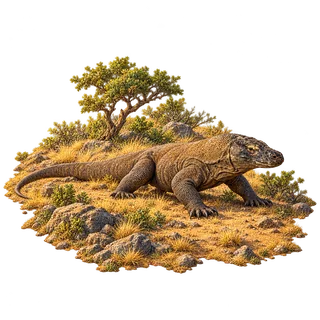
Loh Liang is a named gateway to Komodo Island within Komodo National Park. The park protects much more than one remarkable reptile: its dry climate supports grass-woodland savanna and tropical deciduous forest, alongside coastal and marine habitats. This representative dragon stands among dry grasses, rocks and low trees. Reading the habitat alongside the animal helps explain why conserving the landscape matters as well as recognising its best-known resident.
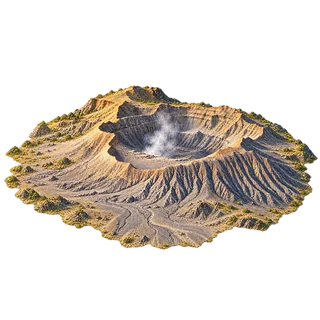
Mount Bromo stands within the volcanic landscape of Bromo Tengger Semeru National Park in East Java. The surrounding sand sea and nearby cones make the view a lesson in different volcanic forms. Bromo’s open, active crater is different from the intact grooved silhouette of neighbouring Batok.
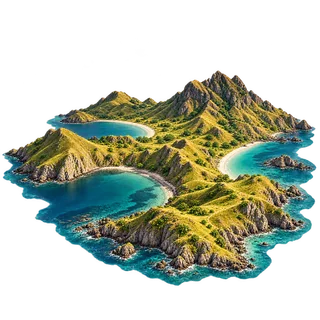
Padar is one of the islands within Komodo National Park. From its well-known hill view, branching ridges separate several curved bays. The official tourism description notes how the hills change appearance with the seasons: wetter months bring greener grass, while the dry season produces a more ochre landscape. The illustration brings those land-and-water relationships together as a representative view, rather than treating every painted shoreline as a cartographic boundary.
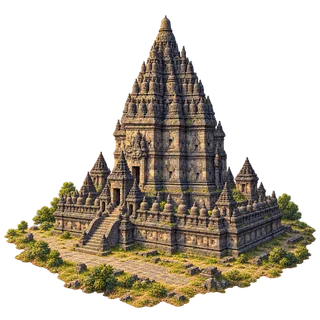
Prambanan’s main temple is dedicated to Shiva. Its square foundation supports a deeply articulated stone body and a roof that narrows through successive tiers to a single pinnacle. The Yogyakarta heritage registry records a 34-metre square foundation and a total height of 47.6 metres. A gallery around the temple carries Ramayana reliefs. The surviving building combines ancient stonework with a long history of restoration, including the completion of its principal twentieth-century rebuilding in 1953.
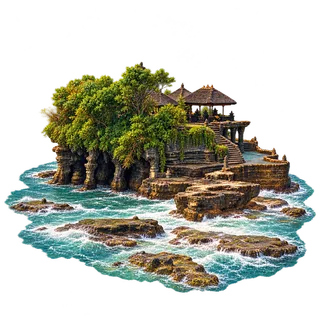
Tanah Lot is a living Hindu sea temple in Beraban, Tabanan. Its shrines stand on a rocky coastal outcrop that becomes surrounded by sea at high tide; lower water exposes part of the approach. The layered rock, trees, steps and modest pavilion roofs form one connected landmark. Stories about Dang Hyang Nirartha belong to the site’s religious and cultural traditions, but the illustration does not present a miraculous movement of the rock as documented geological history.
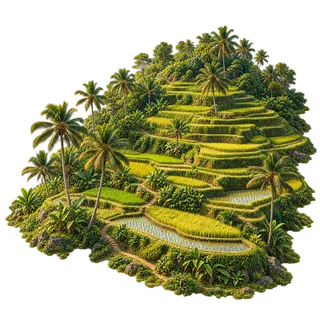
The Ceking or Tegallalang terraces near Ubud are working agricultural land, not simply green decoration. Earth banks divide the sloping ground into stepped rice plots, while irrigation supports cultivation. The landscape changes with planting and harvesting: young crops, mature rice and recently worked plots need not look alike. Bali’s subak traditions place water management within community life, but these particular tourist terraces should not automatically be described as one of UNESCO’s listed component sites.
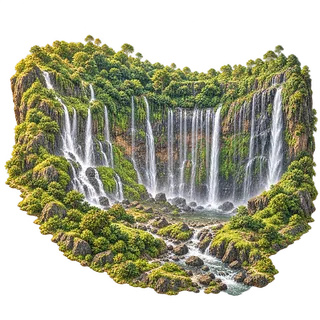
Tumpak Sewu, also called Coban Sewu, lies at the Lumajang–Malang boundary in East Java. Streams descend around a broad curving cliff into a rocky gorge, creating the landmark’s many-ribbon appearance. The connected river landscape crosses an administrative boundary: Lumajang’s government describes cooperation over the Glidik River and local tourism management. The miniature follows the waterfall amphitheatre rather than replacing it with one single horizontal sheet of water.
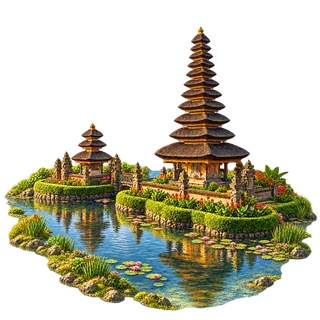
Ulun Danu Beratan belongs to Bali’s living Hindu sacred landscape. Its lakeside pair contrasts a tall tiered meru with a smaller three-tier shrine. Their different heights make the forms recognisable, while their lakeside setting connects architecture with the importance of water. The illustration concentrates on their public exterior forms and planted platforms rather than inventing an interior ceremony or treating the temple as an abandoned monument.
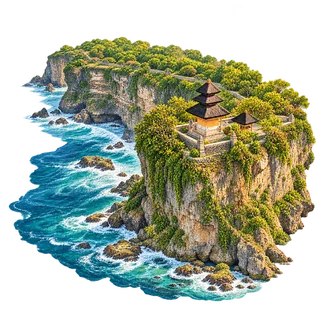
Uluwatu Temple stands on the southwestern coast of Bali’s Bukit Peninsula. Its cliff-edge position is central to the landmark: low temple structures meet a steep limestone coast and a path that follows the headland. The miniature keeps the shrine small relative to the cliff, preserving the relationship between architecture and landscape. It shows a public exterior view of a place that continues to have religious significance, with no invented ceremony or interior scene.