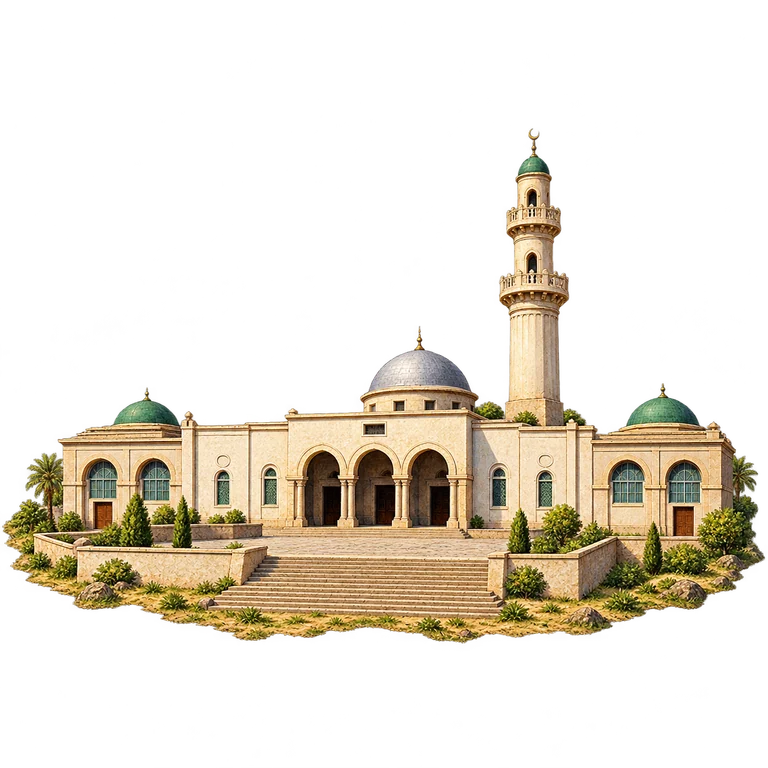
The Great Mosque, also called Al Khulafa Al Rashiudin, is a prominent place of worship in Asmara. Its low frontage is organised around three central arches, with smaller domed sections at the sides. A tall minaret gives the building a very different outline from the nearby churches. UNESCO’s account of the city highlights the bell towers, spires and minarets that reveal the presence of its diverse communities.
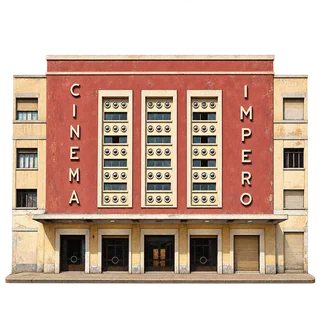
Cinema Impero stands on Harnet Avenue in Asmara. The state’s World Heritage nomination records Mario Messina’s1937 design and explains that the built complex was more modest than the original proposal. Its street facade is still distinctive: three pale vertical panels combine strip windows with rows of circular lights, while the cinema’s name runs down either side. The building belongs to the city’s colonial history and its later life as an Eritrean urban landmark.
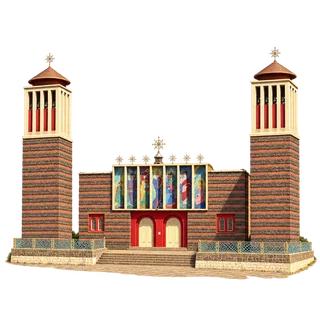
Enda Mariam is an Eritrean Orthodox church in Asmara. Its exterior brings together layered stone walls, red entrance surrounds and two tall square bell towers. At the top, narrow openings and wide overhanging roofs change the rhythm of the stonework below. Colourful religious panels appear across the central front. This is one part of the city’s varied religious architecture, which UNESCO identifies as an important expression of its communities.
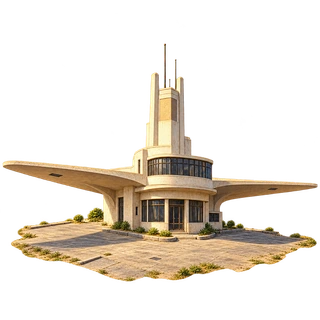
Designed by Giuseppe Pettazzi and completed in 1938 during Italian colonial rule, the building gave an everyday service station an aeroplane-inspired form. Its broad concrete canopies project outward without posts beneath their outer spans.
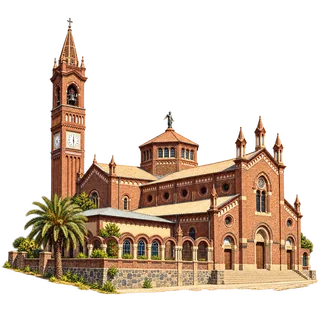
The Church of Our Lady of the Rosary has a long brick nave, a rose window above its front entrance and a tall bell tower. Look for the contrast between the low roofline and the pointed spire. It belongs to the diverse religious townscape that UNESCO describes in its account of Asmara, where churches, mosques and other community buildings share the city. Often nicknamed the cathedral, its precise public name here is the Church of Our Lady of the Rosary.
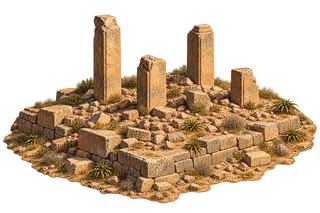
Qohaito occupies a plateau in southern Eritrea. Its archaeological remains belong to a wider settlement landscape near routes linking the Red Sea port of Adulis with inland centres. The evidence invites questions about trade, agriculture and local production, while the plateau also remains a place used by Saho farming and pastoral communities.