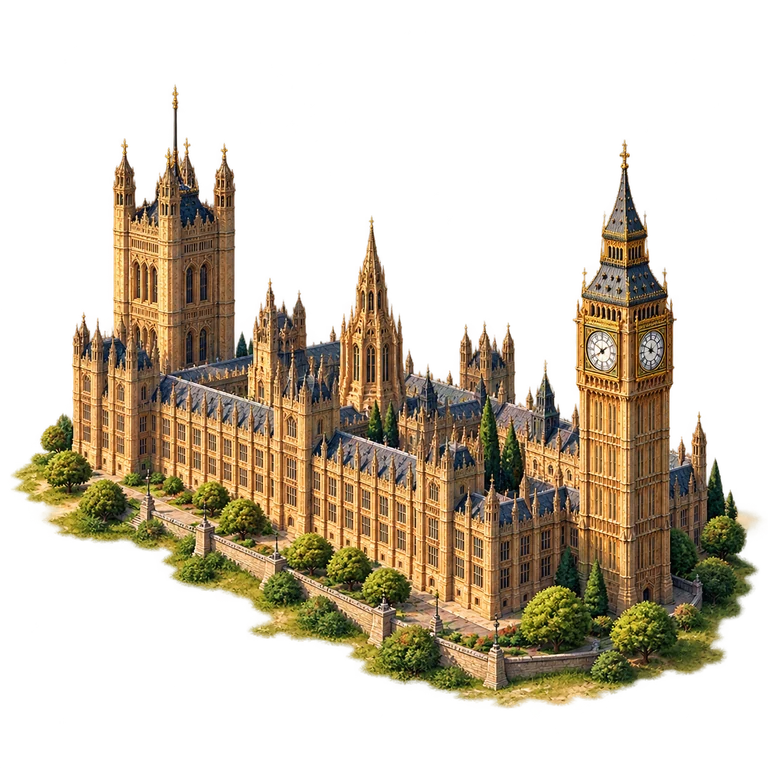
The Palace of Westminster stands beside London's River Thames. A devastating fire in 1834 led to the construction of the new palace, designed by Charles Barry with Augustus Welby Pugin contributing to its Gothic Revival character. Its clock tower became one of London's most familiar silhouettes. The Great Clock began operating in May 1859, and the Great Bell first sounded that July. Looking along the riverside frontage, the long parliamentary buildings and their towers form a single architectural composition rather than an isolated clock tower.
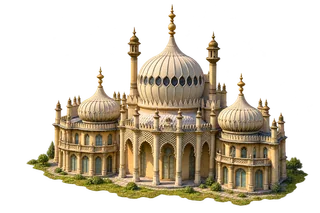
The Royal Pavilion was created as a seaside palace for the future George IV in Brighton. John Nash began its dramatic transformation in 1815, adding the distinctive domes and slender turrets. The exterior draws on Indian architectural forms. Look for the large central onion dome above the latticed arches, flanked by smaller domed bays. The illustration shows a bounded central frontage.
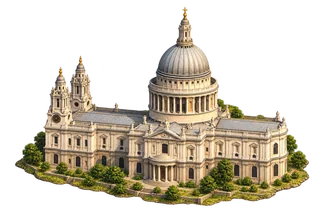
Christopher Wren designed the present St Paul’s after the Great Fire of London. Its dome and lantern became familiar parts of the city’s skyline. Parliament declared the new cathedral complete in 1711. Look for the contrast between the great round dome, the smaller western bell towers and the long roof below. The miniature follows the cathedral’s southern side.
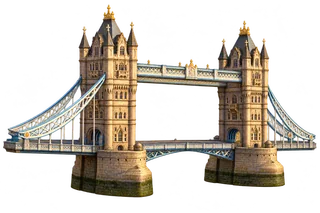
Tower Bridge was built between 1886 and 1894. Beneath its stone exterior is a steel structure, and the central roadway has two moving sections called bascules. They rise to let vessels pass. High walkways connect the towers above.
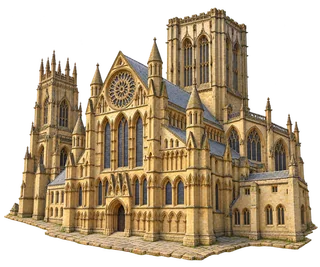
York Minster is a Gothic cathedral whose different spaces were built across several generations. Its south transept carries a large rose window, while the square central tower rises behind the crossing. Look for the rows of pointed arches and the small corner turrets.