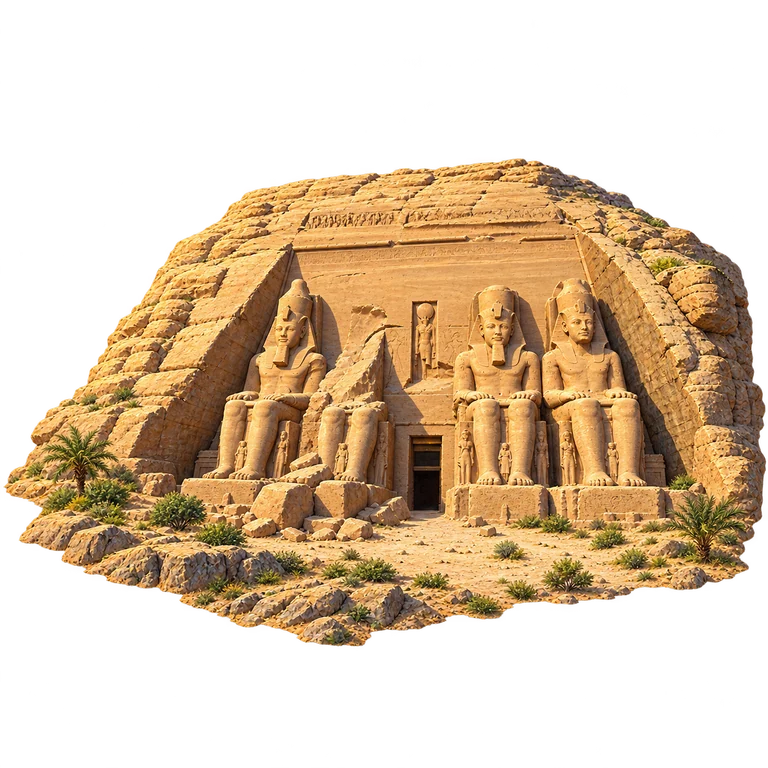
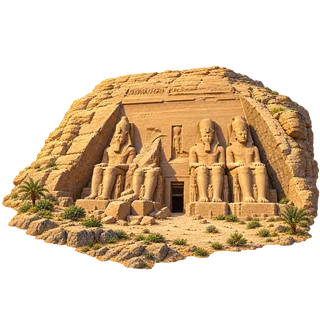
Ramesses II’s Great Temple at Abu Simbel was cut into rock and given a façade dominated by four seated colossal figures of the king. One lost its upper body in an ancient collapse; the fragments remain part of the surviving scene. When the High Dam project threatened the Nubian monuments, an international campaign relocated the temples to higher ground. The present exterior therefore tells a story of ancient carving and modern conservation together.
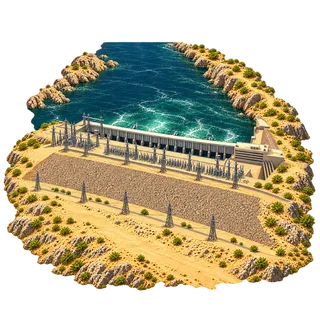
The Aswan High Dam is a broad rock-fill embankment built to regulate the Nile and store water between years. Water is directed through tunnels to turbines that generate electricity. The low downstream powerhouse, switchyard and tailwater form one working component of this much larger system. The reservoir also transformed the surrounding region and prompted the international rescue of Nubian monuments, including Abu Simbel and Philae.
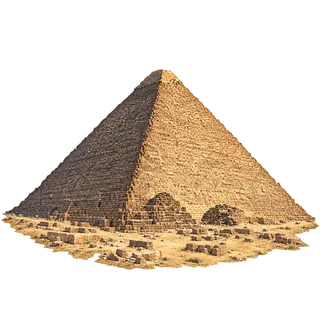
The Great Pyramid was built as Khufu’s tomb. Its present stepped texture exposes local limestone masonry that was originally covered with finer limestone casing. That outer stone came from Turah and was transported by ship. The contrast between rough core and finished surface offers a different way to read the monument: its appearance records both the builders’ materials and what has survived.
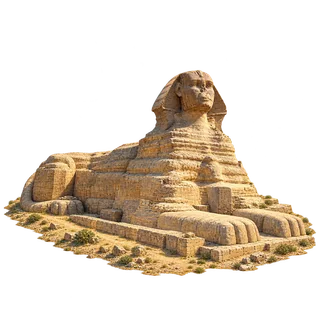
The Great Sphinx combines a king’s head with the body of a lion, an ancient Egyptian expression of royal power. It was carved directly from the bedrock. Archaeological evidence links it with Khafre’s reign and the nearby temple complex. Its weathered layers and later stone repairs remain visible, so the surviving sculpture is more than an unchanging silhouette: it is an ancient form that has also been conserved over time.
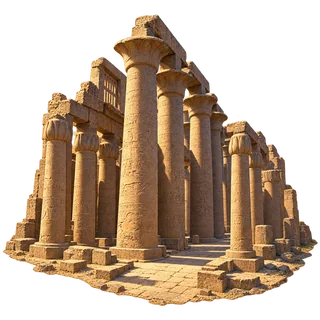
Karnak’s Great Hypostyle Hall contains 134 sandstone columns. Twelve taller columns line its central nave, with open capitals shaped like papyrus blossoms; the surrounding columns are shorter and have closed-bud forms. The difference in height helped support a raised roof and clerestory windows. Today the surviving columns, beams and grille fragments make that structural arrangement visible even where the roof is gone.
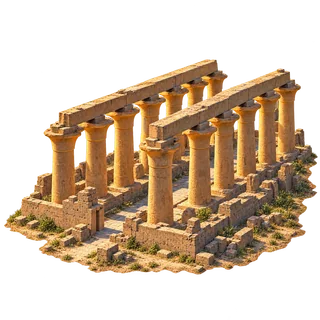
Amenhotep III built Luxor Temple’s Great Colonnade with two rows of seven large columns. Its decoration was developed under later rulers, including Tutankhamun and Horemheb, and recorded the Opet Festival procession between Karnak and Luxor. The long passage belongs to a temple shaped by several reigns rather than one single building moment. Its surviving open capitals and stone beams preserve the rhythm of that route.
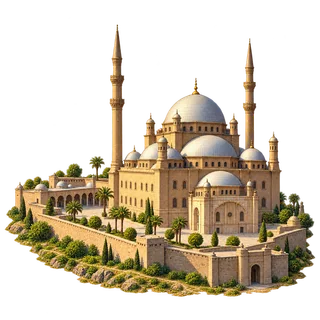
Muhammad Ali Mosque stands within Cairo’s Citadel and draws on Ottoman architectural forms. A large central dome covers the prayer hall, supported visually and structurally by surrounding half-domes; an open courtyard forms a different kind of space beside it. The pale wall facing gives the building its familiar Alabaster Mosque name. Its layered roof and paired slender minarets distinguish it from the other monuments within the much larger citadel.
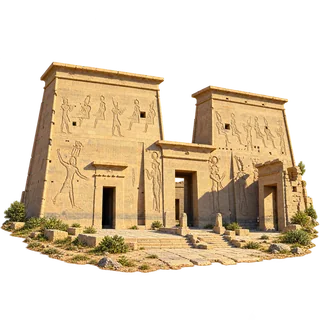
Philae’s Temple of Isis developed mainly in the Ptolemaic period and continued in use into the Byzantine era. Its monuments once stood on Philae Island. To save them from flooding associated with the dams at Aswan, the Nubian rescue campaign moved them to nearby Agilkia. The temple’s first pylon now opens the approach to a place whose ancient fabric survives in a different island setting.
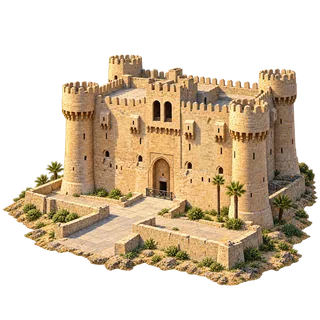
Sultan Qaitbay built the coastal citadel in the late fifteenth century over the remains of Alexandria’s ancient lighthouse. Its main keep is a three-storey square mass with rounded corner towers. Enclosing walls and internal rooms served defence, storage and accommodation. The surviving fortress belongs to a different period from the lighthouse that once occupied the site, so the illustration shows the keep rather than inventing the lost ancient tower beside it.
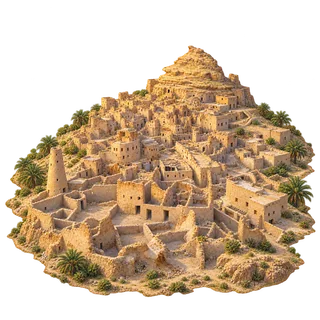
Shali’s old fortified settlement was built from a local mixture of clay and salt. Its closely grouped houses, lanes and religious buildings formed a distinctive oasis town. Conservation work has stabilised vulnerable walls and reopened passages while retaining the ruined fabric. Looking over the stepped cluster makes its material and layout visible without pretending every damaged room has been rebuilt or assigning a new identity to an unnamed house.
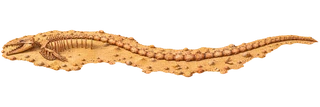
Wadi Al-Hitan in Egypt's Western Desert preserves fossils of ancient whales known as archaeocetes. Their anatomy records stages in the evolution of whales from land-dwelling ancestors towards marine life. Other fossils help reconstruct the environment in which those animals lived.
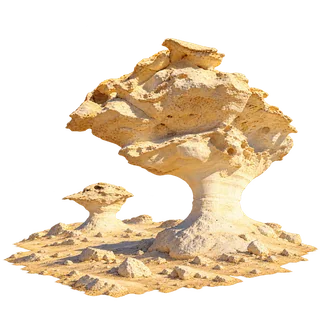
The White Desert takes its name from its pale chalk floor and rock formations. Wind erosion has shaped exposed chalk into columns, broad caps and irregular mushroom-like forms. Their light colour and pitted surfaces distinguish this landscape from a field of snow or from a built stone monument. The scene represents a small group of these natural forms within the protected desert landscape, rather than an invented rock with an exact tourist nickname.