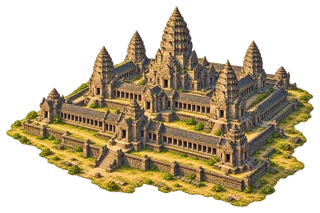
Angkor Wat’s central temple stands within much larger moated grounds near Siem Reap. Galleries surround stepped levels, and the tower group rises above them. The distant moat, long approach and broad wooded grounds are left outside the scene, so look for the connected galleries beneath the skyline.
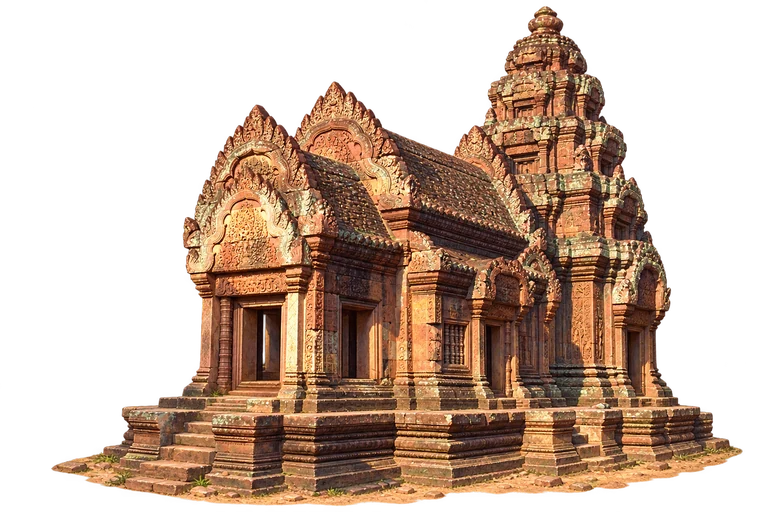
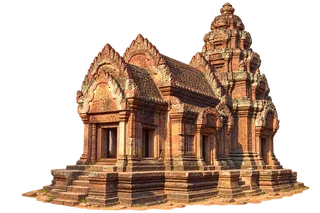
Banteay Srei was dedicated in 967 and is celebrated for the refinement of its sandstone sculpture. The small temple combines intricately carved pediments, door frames and compact towers. Its scale makes the detail feel especially close. The main sanctuary was dedicated to Shiva, while the temple's carved narratives draw on a wider range of Hindu stories. Here the central shrine and attached entrance hall form the illustrated component.
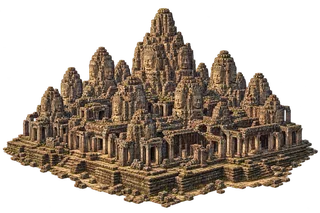
Bayon stands at the centre of Angkor Thom, the city associated with King Jayavarman VII. Built towards the end of the twelfth century, its complex architecture is famous for towers bearing serene carved faces. Their identities and meanings have inspired discussion, so it is better to look carefully than assign every face a simple label. Galleries, terraces and towers make this a richly layered place to explore.
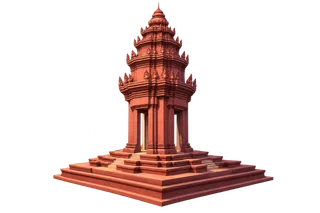
Phnom Penh's Independence Monument was erected in 1958 to commemorate independence from France in 1953. Its stacked ornamental tiers rise above tall open portals, borrowing a recognisable Khmer architectural vocabulary. The monument is part of the modern capital's public landscape and a setting for national commemorations. Look at how a relatively narrow tower gains a strong silhouette through its layered edges and lotus-like summit.
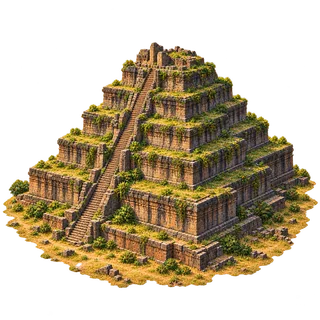
Prasat Prang rises within the Prasat Thom complex at Koh Ker. Its stacked terraces and steep central staircase give it a striking pyramid form. Koh Ker was the Khmer Empire’s sole capital from 928 to 944 under Jayavarman IV. This is one monument within that much larger sacred city, whose builders worked with enormous stone blocks.
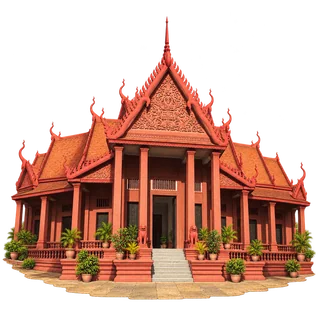
The National Museum of Cambodia opened in Phnom Penh in 1920. George Groslier designed its red buildings by reinterpreting Khmer architectural forms for a museum. This entrance frontage leads into a collection of sculpture, ceramics and other cultural objects spanning many periods of Cambodian history. Look for the richly decorated gable above the tall columns.
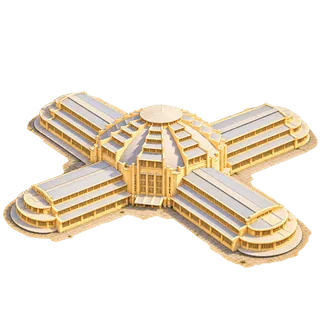
Phsar Thmey, or New Market, is a landmark of Phnom Penh’s Art Deco architecture. Opened in 1937, it gathers four long roofed halls around a broad central dome. Its pale yellow surfaces and stepped roof ribs make an unmistakable outline. Beneath those roofs, the market brings together sellers of food, clothing, jewellery and everyday goods.
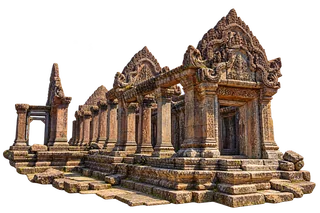
Preah Vihear is dedicated to Shiva and was developed along an unusually long axis. Pavements and staircases link a succession of sanctuaries across its plateau setting. Much of the complex dates from the early eleventh century, with a longer history behind it. The surviving stone architecture combines substantial door frames with finely carved pediments.
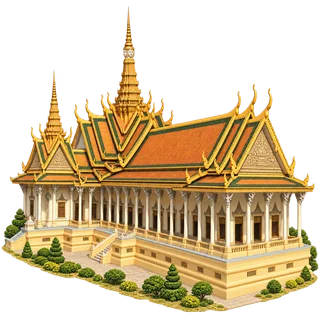
The Throne Hall is a ceremonial building inside Phnom Penh’s Royal Palace. Coronations and official ceremonies take place here. Its cream columns and orange-and-green roof lead the eye toward a tall golden spire. The hall is a distinct part of the palace complex, alongside other buildings with different roles.
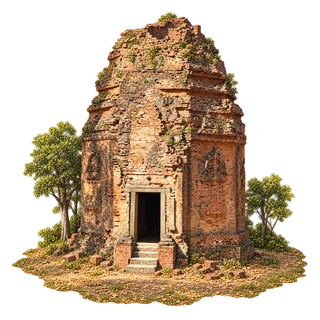
Sambor Prei Kuk is associated with ancient Ishanapura, a capital that flourished in the late sixth and early seventh centuries. Its temple groups include unusual octagonal structures and decorated sandstone elements. The architectural language developed here helped shape later Khmer building traditions.
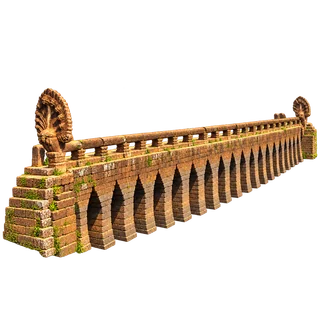
Spean Praptos, also known as Kampong Kdei Bridge, belongs to Cambodia’s historic road network toward Angkor. It crosses the Chikreng River. Its long laterite body stands on a close procession of narrow corbelled openings, where stone courses step inward above each gap. A naga balustrade runs along the deck.
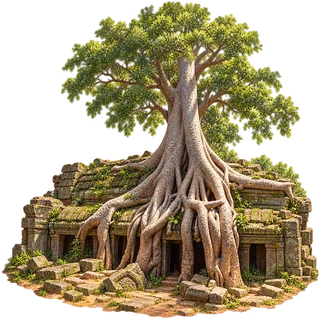
At Ta Prohm, huge tree roots wrap around sandstone galleries and descend beside dark doorways. Jayavarman VII dedicated this Buddhist monastery in 1186. Its original name, Rajavihara, meant royal monastery. The encounter between tree and stone is carefully conserved: the romantic-looking ruins have also needed consolidation and restoration.
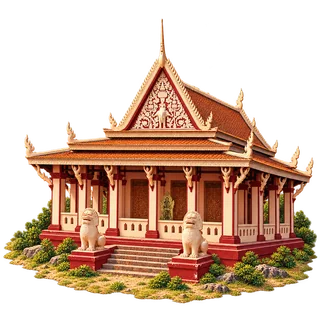
Wat Phnom’s hill is tied to the founding legend of Phnom Penh. The story tells of Daun Penh finding sacred images and raising a shrine for them. The main sanctuary seen today has been rebuilt several times. Look for the ornate triangular roof front and the guardian lions beside its steps; the large stupa nearby is a separate monument.