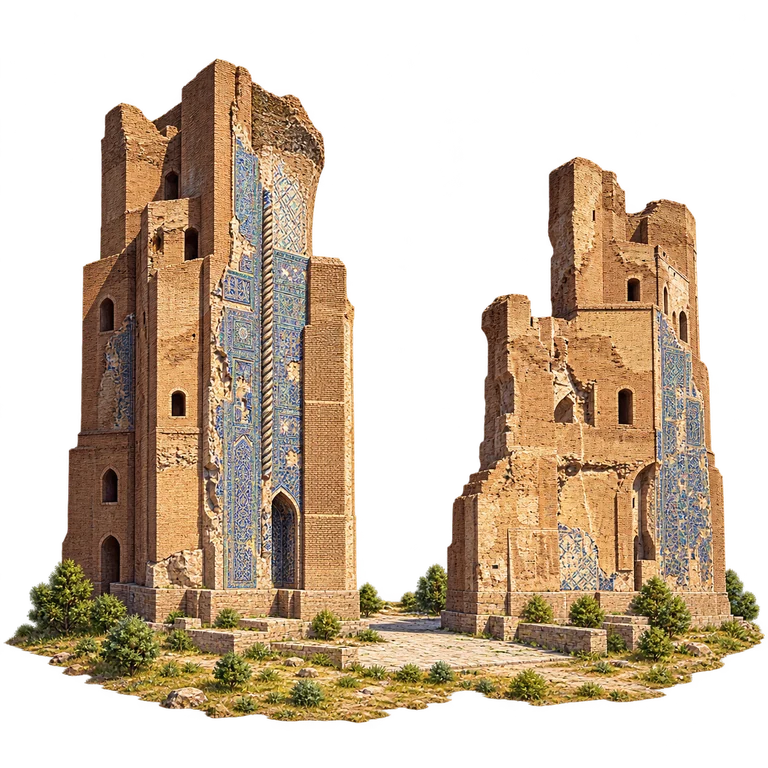
Ak-Saray was begun in 1380 at Shahrisabz as a palace for Timur. Much of the building has disappeared, but the great entrance supports still communicate its ambition and scale. Fragments of glazed decoration cling to the brickwork. The open gap between the surviving pylons matters as much as their height: it marks a lost arch rather than a completed gateway.
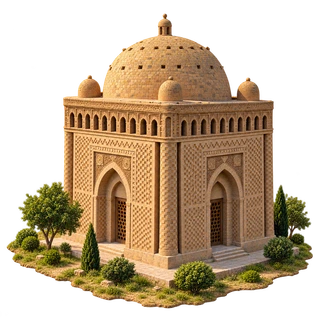
Bukhara's historic centre developed over more than two thousand years along Silk Road routes. Its surviving urban fabric includes the tenth-century tomb of Ismail Samani and numerous seventeenth-century madrasas. Together, streets and buildings reveal a city shaped by learning, religious life and long-distance connections.
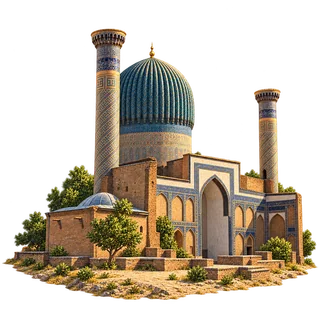
Gur-e-Amir is the mausoleum associated with Timur and members of his family in Samarkand. Its great ribbed dome and decorated drum draw the eye above a more compact brick body. Glazed surfaces catch light differently from the recesses beneath the arches, making structure and ornament work together. The building is a place of remembrance within a city whose monuments preserve several periods of Central Asian history.
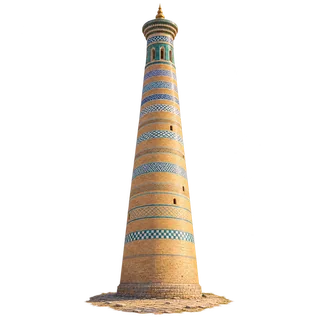
The Islam Khodja Minaret belongs to an early twentieth-century complex in Khiva. Its shaft narrows as it rises, with bands of glazed ornament breaking up the warm brickwork. The tower stands beside a madrasa and mosque, joining places for study and worship. Looking from the broad base toward the lantern at the top reveals how taper and repeated pattern give a tall structure a light, upward movement.
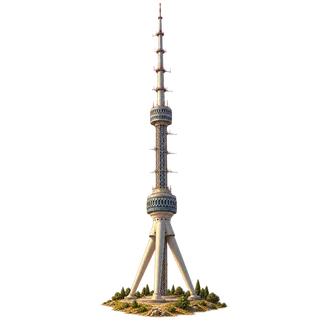
Tashkent Television Tower opened in 1985. A central trunk, a lattice frame and a tripod of supporting legs work together in its 375-metre structure. Broadcasting equipment shares the tower with observation spaces, joining communications engineering with a view over the city. Its broad lower support and narrow antenna make different structural jobs visible. The tower’s modern steel silhouette offers a different chapter of Uzbekistan’s built history from its brick monuments.
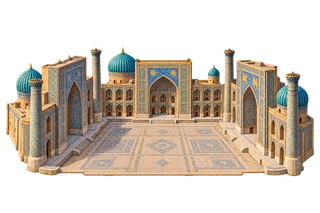
The Registan brings the Ulugh Beg, Sher-Dor and Tilya-Kori madrasas together around an open square. Tall tiled portals give each building its own presence while the three form a single urban ensemble. The square served as a centre of trade before becoming a ceremonial setting under Ulugh Beg. Its name is associated with a sandy place.