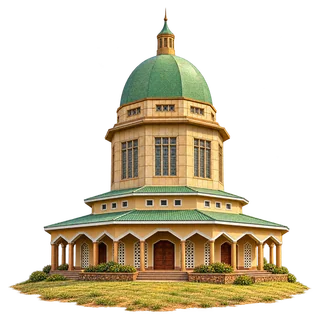
Kampala’s Bahá’í House of Worship stands on Kikaya Hill. Its nine-sided form expresses a theme of unity, while the green dome gives the building a clear silhouette. The surrounding garden offers a quiet setting above the city.
Kasubi occupies a hillside in Kampala. A former palace, built in 1882, became a royal burial place in 1884. Its circular main building uses organic materials including wood, thatch and reeds. The place's significance also rests in continuing spiritual values and identity, which cannot be conveyed by its architecture alone.
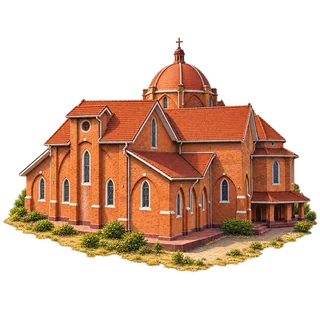
Namirembe Cathedral is an Anglican landmark above Kampala. The present building was completed in 1919. Red brick walls, pointed windows and the roof crossing give its hillside silhouette a character distinct from the city’s other places of worship.
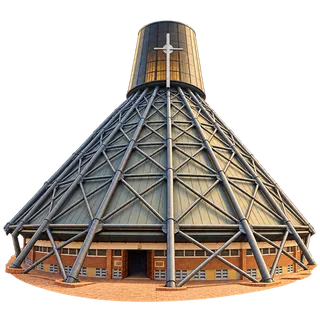
The Catholic basilica at Namugongo commemorates the Uganda Martyrs. Pilgrims gather at the shrine, especially around 3 June. Its broad conical roof and radiating structural lines make a striking modern memorial building.
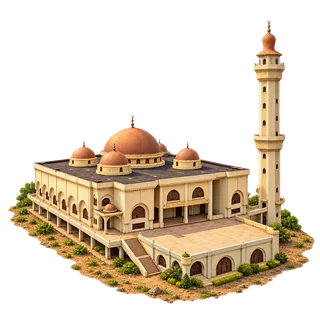
The Uganda National Mosque is a major place of worship in Old Kampala. Its prayer hall is gathered beneath a large dome, with smaller domes and a tall minaret shaping the skyline.