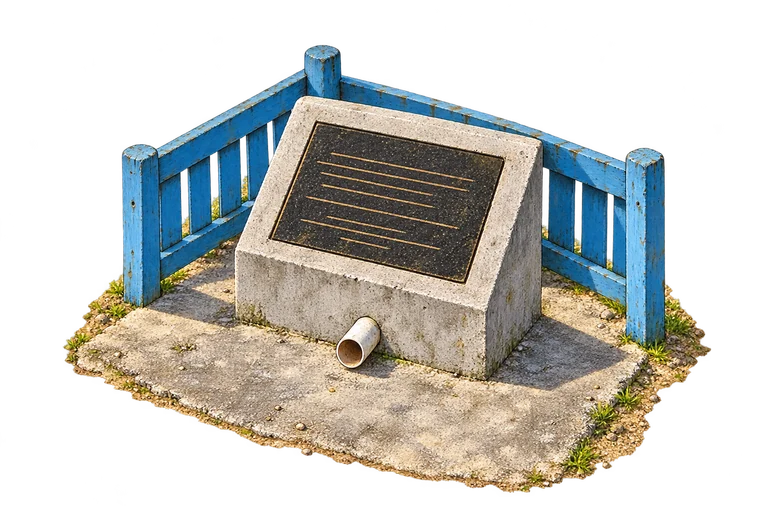
At Te Vili O Tavita, or David’s Drill, a modest marker recalls Royal Society drilling expeditions to Funafuti between 1896 and 1898. The work investigated the subsurface structure of a coral atoll in the long debate over Darwin’s theory of atoll formation. Edgeworth David led the 1897 expedition. The International Union of Geological Sciences recognises the site’s place in the history of geoscience—a large scientific question remembered by a small local monument.
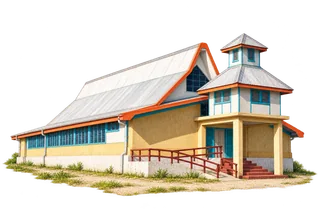
Fetu Ao Lima is identified as Funafuti Church on the Pacific Islands Centre’s local tour map. Its photographed frontage combines a long nave, blue-green windows and a small square bell tower over the entrance. The church forms part of the community landscape of Fongafale, where meeting halls, places of worship and everyday institutions stand close together on a narrow strip of land.
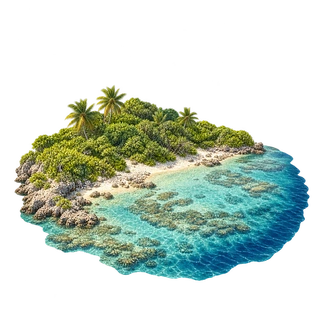
Funafuti Conservation Area is defined across a part of the atoll's marine landscape. Its northern boundary follows a channel between islets, while other limits use depth contours along the lagoon and ocean-facing reef slope. The mapped area shows how conservation geography can be drawn through water using features that are partly hidden below the surface.
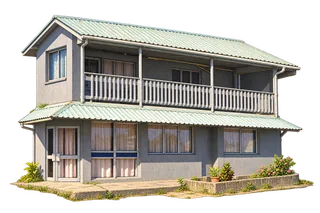
The National Bank of Tuvalu is established under Tuvalu’s banking legislation. Its Vaiaku building is an everyday part of the country’s public and economic life, rather than a monumental banking palace. In the photographed frontage, an open upper balcony shades simple doors and windows, with another awning protecting the ground floor. It offers a glimpse of how national institutions fit into the compact built landscape of Fongafale.
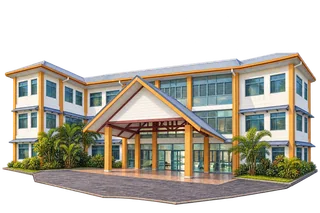
Tuvalu’s main Government Building brings national administration into a compact part of Vaiaku on Fongafale. The Department of Trade gives this building as its office address, while regional energy reporting records the office building as an important public facility. Blue-green glazing, white walls and yellow vertical bands surround its gabled entrance canopy. It is a practical civic landmark in a capital whose institutions share very limited land.