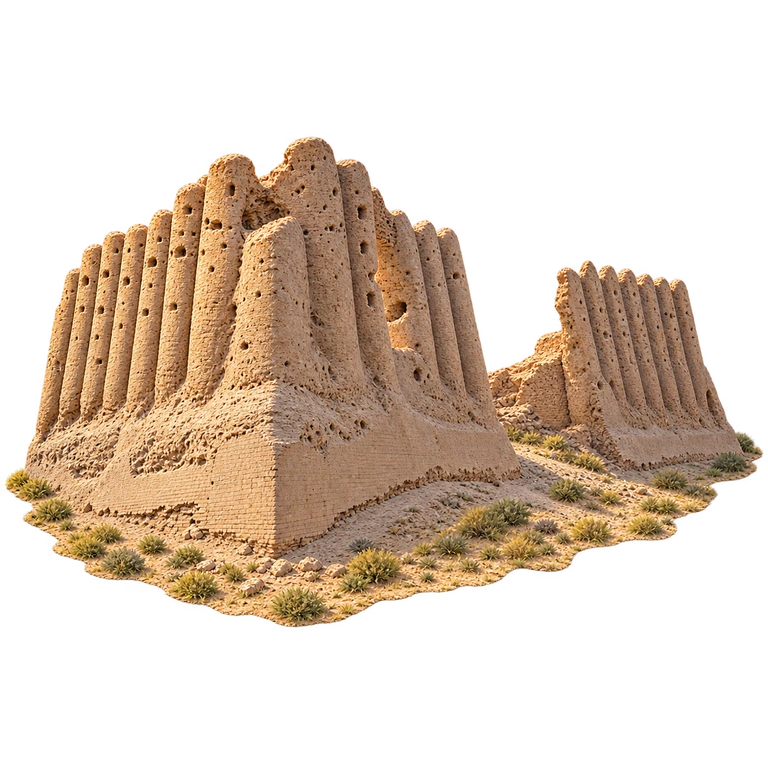
Ancient Merv's oasis contains remains spanning around four millennia. Successive urban areas and monuments reveal changing settlement over that long period. The historic core includes Erk Kala, Gyaur Kala and Sultan Kala, allowing the landscape to be read as overlapping cities rather than the remains of just one building campaign.
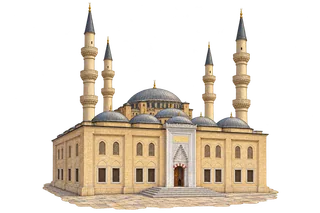
Ertuğrul Gazi Mosque is a modern mosque in Turkmenistan's capital. Its pale facade, central dome and four minarets draw on Ottoman architectural forms. The long entrance elevation uses repeated windows and a central portal, while smaller domes soften its roofline.
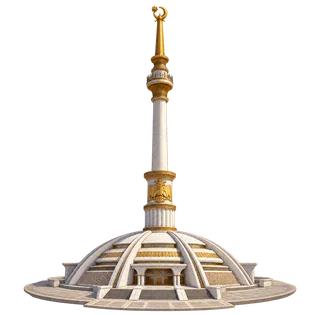
Ashgabat's Independence Monument commemorates Turkmenistan's independence. Its design contrasts a very tall slender shaft with a broad rounded base, using white surfaces and gold ornament. The surrounding park contains fountains, ceremonial routes and sculpture, but the central tower is its most distinctive feature. Look from the low roof toward the balconies and crescent ornament to see how the design changes as it rises.
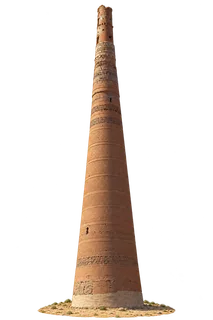
Kutlug Timur Minaret stands among the monuments of Kunya-Urgench in northern Turkmenistan. Its circular brick shaft narrows upward, carrying bands of ornament and inscriptions. The surviving tower has a slight lean and an irregular upper end. Scholars have debated its construction history, so the ruin is best appreciated as evidence to study rather than a perfectly restored monument.
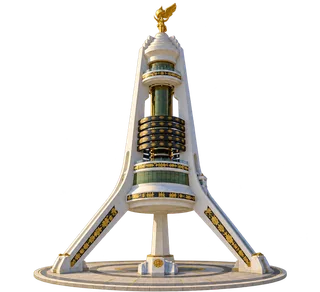
The Neutrality Monument is one of Ashgabat's distinctive modern landmarks. Its documented tripod form uses three splayed supports around a central tower with observation levels, dark glazing and gold decoration. A gilded sculpture crowns the structure. The monument is associated with Turkmenistan's policy of neutrality, while its unusual engineering gives it a silhouette quite different from the nearby city's other columns and domes.