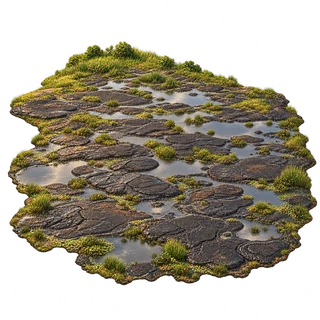
Pitch Lake at La Brea contains asphalt mixed with water, gas and mineral matter. Although its surface can appear still, the material moves slowly, and areas of water vary with the season. The deposit has also supported an industry supplying asphalt for roads and other manufactured products.
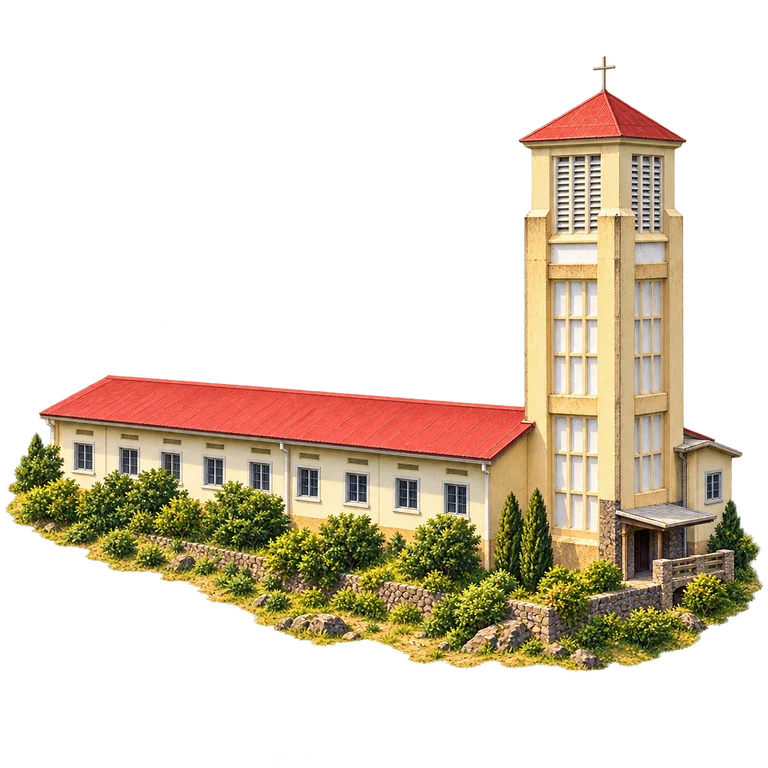
Mount Saint Benedict is the Abbey of Our Lady of Exile above Tunapuna. Benedictine monks from Bahia in Brazil founded the monastery in 1912. Its community combines prayer with work and welcomes visitors of different beliefs. The bell-tower frontage has a simple character: pale walls, long white louvres and a shallow red roof. Look along the attached low wing and then back up the tower. This modest architectural excerpt offers a recognisable part of the abbey without turning the entire forested hillside into a miniature.
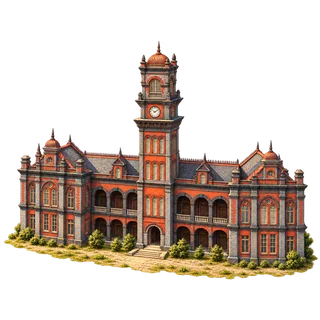
Queen’s Royal College’s main block is one of Port of Spain’s Magnificent Seven landmarks. Its foundation stone was laid in 1902, and the National Trust identifies Daniel M. Hahn as its designer. The main block combines a strong central clocktower with red masonry, contrasting grey trim and shaded open galleries. Look from the tower towards the two end pavilions: repeated arches and tall windows give the frontage a steady rhythm. It was designed for education, even though its imposing silhouette can look palatial.
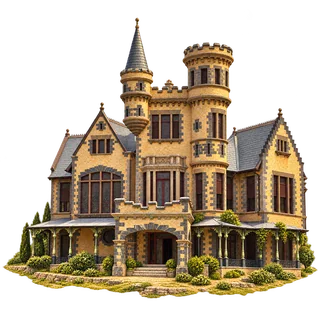
Killarney, commonly called Stollmeyer’s Castle, stands on Maraval Road in Port of Spain. Built between 1902 and 1904 for Charles Fourier Stollmeyer, it was designed by Robert Gillies in a Scottish Baronial style. Its pale local stone, darker contrasting blocks, steep roofs and unequal towers make it look like a small castle, but it began as a residence. Notice how the broad battlemented tower differs from the narrow pointed turret. The building’s two familiar names connect it with both its original household and its later public history.
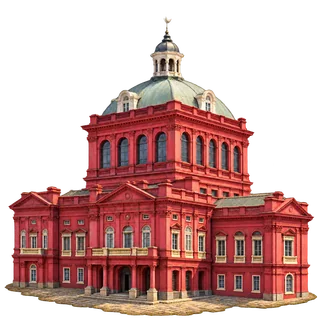
The Red House is the home of Trinidad and Tobago’s Parliament in Port of Spain. The present building opened in 1907 after its predecessor was destroyed during the 1903 Water Riots. Its name recalls the red paint applied to the earlier government buildings in 1897. The central pavilion brings together arched upper windows, classical ornament and a pale metal dome. Parliament returned after a major restoration in 2020. Look up towards the small cupola: even this compact part of the building carries a distinctive skyline.