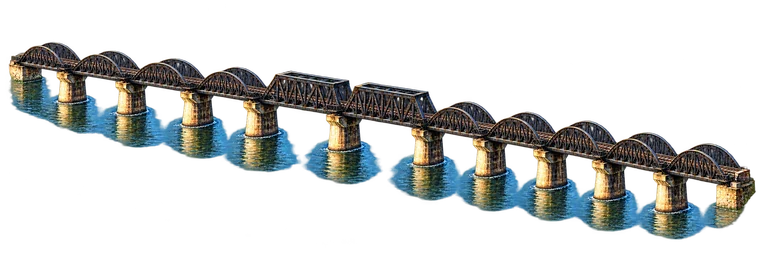
The steel bridge at Kanchanaburi is part of the railway built during the Second World War using forced labour, including Asian labourers and Allied prisoners of war. Its history is remembered alongside the railway and nearby war cemetery. Look at the current bridge’s mixed shapes: curved older spans contrast with straight-sided replacements installed after wartime damage.
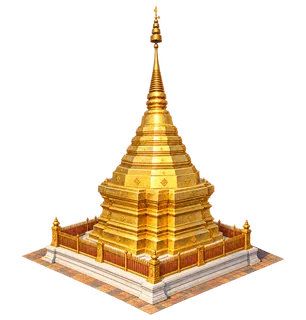
Wat Phra That Doi Suthep is one of Chiang Mai's best-known Buddhist temples. Its golden chedi stands within a courtyard surrounded by richly decorated buildings. The layered base and narrowing spire reward a close look, while the temple's mountain setting connects it with the city below.
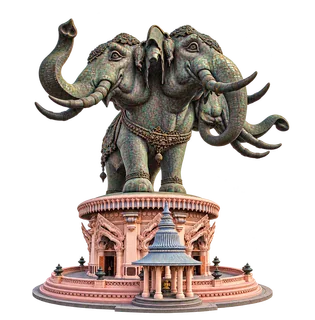
The Erawan Museum brings art, belief and architecture together in an extraordinary form. Its huge copper elephant represents Erawan, the mythic mount of Indra. The museum’s displays extend through three symbolic levels, with the highest inside the elephant itself. Look for the three heads and curling trunks, then the ornate round building and little roofed entrance beneath them.
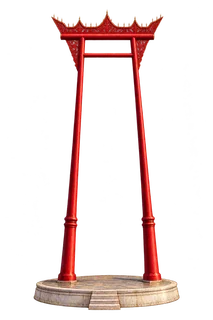
The Giant Swing stands outside Wat Suthat in Bangkok. Its tall timber structure was once used in Brahmanic ceremonies that are no longer performed here. Today the empty red frame is a landmark in its own right. Follow the slender pillars upwards to the carved triangular braces and the sweeping points of the crest board.
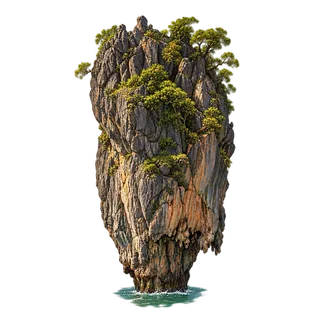
Ko Tapu is a distinctive limestone sea stack beside Khao Phing Kan in Ao Phang Nga National Park. Its broad, rugged upper rock and much narrower base give it an extraordinary silhouette. Cracks and erosion have helped shape the column. Look for the small patches of vegetation finding a foothold high above the water.
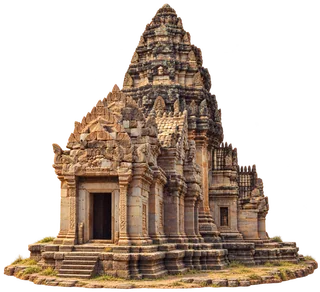
Phimai’s Khmer-style sanctuary stands among the remains of an ancient town in northeastern Thailand. The main stone tower narrows through richly carved tiers above a projecting entrance. Look for the layered pediment, carved doorway and worn steps. The surrounding historical park contains other gateways and buildings, but this view concentrates on the main sanctuary itself.
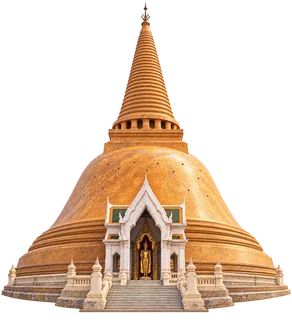
Phra Pathom Chedi is the great landmark of Nakhon Pathom in central Thailand. Its warm golden-ochre surface swells into a broad bell before narrowing through many rings toward the finial. A smaller entrance pavilion provides a striking contrast in scale. The monument belongs to an important Buddhist temple, linking the city's present-day life with a long religious tradition.
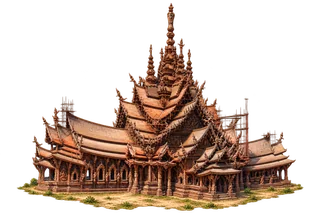
The Sanctuary of Truth is a modern wooden museum project begun in 1981. Traditional carpentry and carved figures turn its walls, posts and roofs into a richly decorated whole. Look at the sweeping roof edges and the small forms climbing towards the central spire. The continuing work is part of the building’s story, rather than evidence of an ancient ruin.
Sukhothai was a capital in the thirteenth and fourteenth centuries. Its monuments combine regional influences and established local traditions into what is known as the Sukhothai style. The historic town is part of a wider property that also includes Si Satchanalai and Kamphaeng Phet.
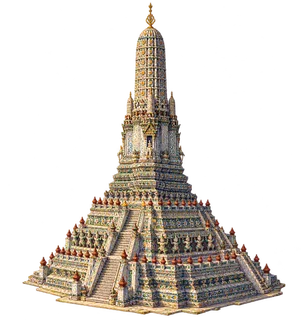
Wat Arun stands on the Thonburi bank of the Chao Phraya River. Its central prang rises through steep tiers toward a narrow summit, with ceramic and porcelain decoration covering its surfaces. From a distance the tower reads as one powerful outline; closer inspection reveals many small colours and forms. Its name is commonly translated as the Temple of Dawn.
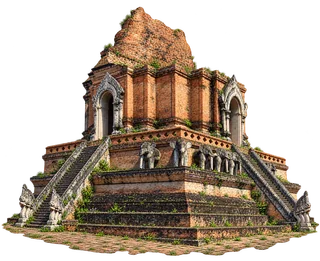
The great chedi of Wat Chedi Luang stands in Chiang Mai’s old city. An earthquake in 1545 damaged its upper part, and later restoration preserved the monument in its ruined form. Look from the long stairways to the elephant sculptures around the base, then up to the decorated shrine niches and the rough surviving brick crown.
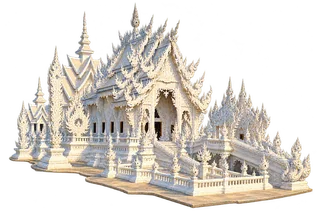
Wat Rong Khun is a modern creative project associated with Thai artist Chalermchai Kositpipat. Its white architecture stands out against the northern Thai landscape. The main hall has layered roofs, curling ornament and reflective details, while an elaborate bridge forms part of its approach. This is a contemporary work, rather than an ancient ruin, inviting visitors to see familiar temple forms through a different artistic imagination.