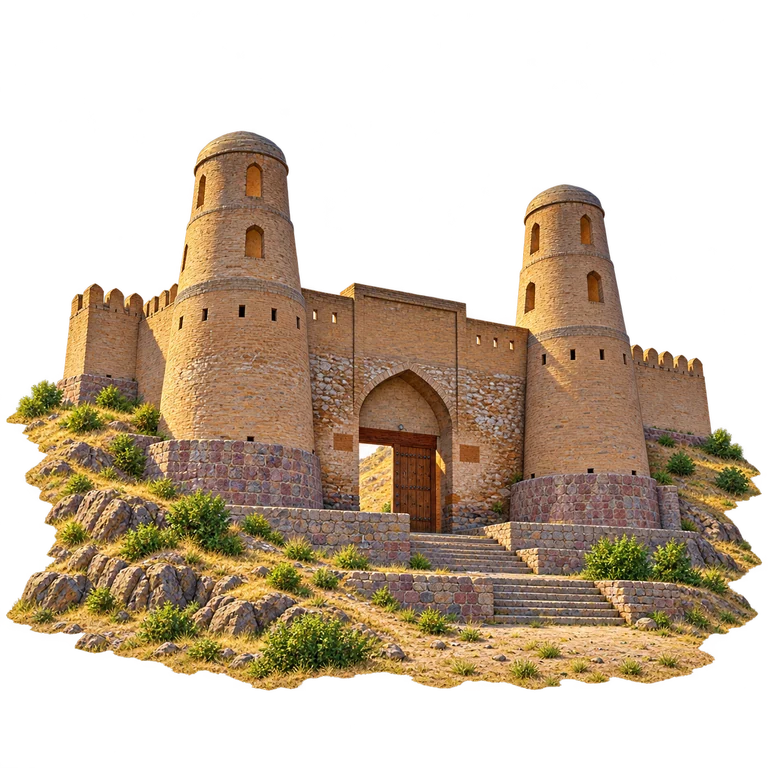
Hisor’s historic reserve brings together a fortress, madrasas and other buildings from different periods. The restored fortress entrance is especially recognisable: two round towers frame a pointed gateway above a short approach. Their compact symmetry differs from the much larger hill behind them. Reading the entrance as a surviving and restored component helps separate the visible monument from the former fortress as a whole. Nearby buildings add other chapters of the settlement’s history.
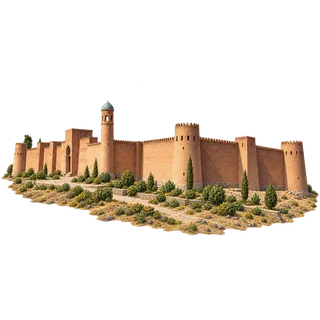
Hulbuk was a medieval town in the region of present-day Kulob and Vose. Archaeology has revealed a fortified palace and other parts of an important urban centre. The visible restored exterior now gives its long walls and projecting towers a strong outline, while the archaeological remains carry evidence of earlier construction. The distinction matters: a conserved frontage helps visitors understand a site, but it is not the same as an entirely intact medieval town.
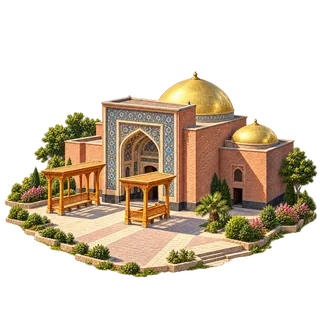
Mir Sayyid Ali Hamadani is remembered as a poet, thinker and Sufi figure. His mausoleum in Kulob remains a place of remembrance within Ismoil Somoni Square. Connected chambers and later additions have shaped the complex over time. The warm brick exterior, blue entrance ornament and rounded golden domes give the public facade a clear identity. Introducing the building through those forms respects its continuing significance without inventing a ceremony or access to its interior.
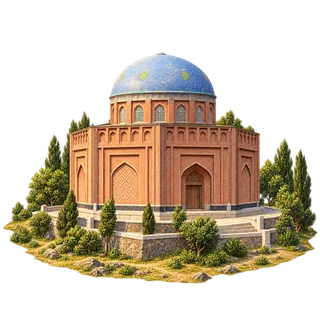
Rudaki is remembered as a foundational poet of the Persian literary tradition. His birthplace at Panjrud, near Panjakent, is associated with a commemorative mausoleum that gives literary memory a physical setting. The pavilion’s red-brick sides, repeated pointed arches and smooth blue dome make a compact, legible form. The later memorial offers a place to remember the poet’s work.
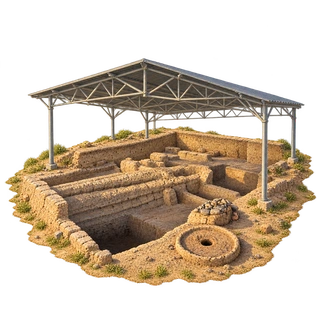
Sarazm preserves evidence of Central Asian settlement from the fourth to the late third millennium BCE. Its position between uplands suitable for pastoralism and a valley suited to irrigated agriculture helped connect different ways of life. Archaeological evidence also records commercial and cultural links reaching towards the Iranian plateau and Indus region.