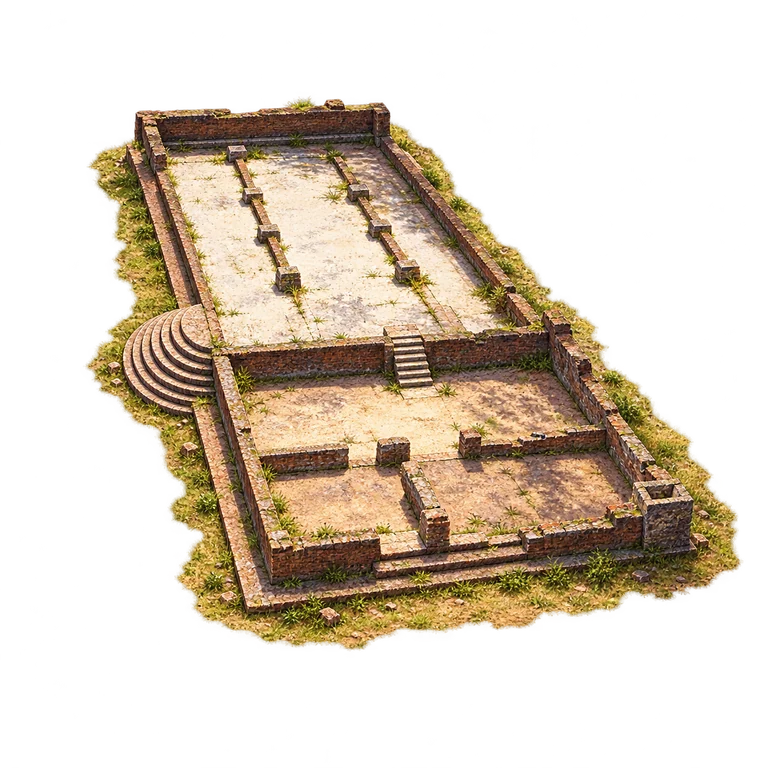
The synagogue at Jodensavanne was consecrated in 1685. Its surviving foundations, floor and entrance steps give clues to a building that no longer has its roof or tall walls. Jodensavanne was a Jewish colonial settlement in Indigenous territory, where free and enslaved people of African and Indigenous descent also lived. The archaeological site preserves this complex history rather than a simple story of prosperity. Follow the low rectangular outline and the curved steps: the remains invite us to imagine cautiously, without turning a ruin into a new building.
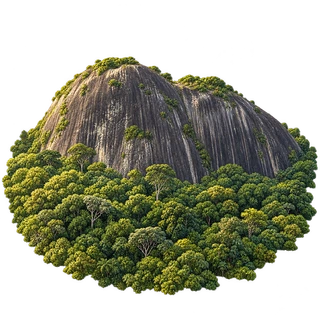
This reserve protects tropical forests and river headwaters in west-central Suriname. Its varied terrain includes lowland and montane forest habitats. Jaguars, tapirs, giant river otters and many birds are among the animals recorded there, linking forest diversity with the waterways running through it.
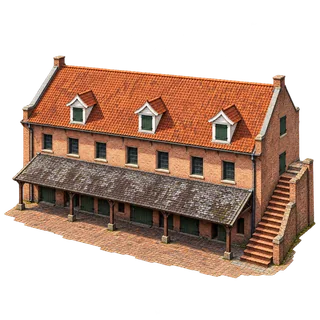
Fort Zeelandia stands by the Suriname River in Paramaribo and houses the Surinaams Museum. The painting follows one brick wing facing its courtyard: green shutters, a tiled roof and a covered lower walkway make it recognisable. The fort’s history reaches beyond military architecture to imprisonment and later political violence, so its museum setting invites careful reflection. Look for the side stair and the contrast between brick walls and timber shelter. This is one bounded part of the fort, not the similarly named ruined stronghold in Guyana.
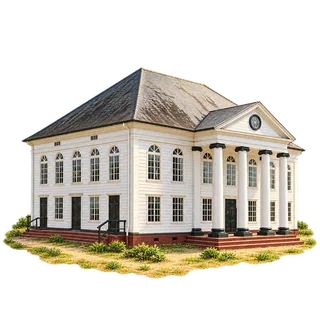
Neveh Shalom is a centre of Jewish life in Paramaribo. Its congregation dates to the early eighteenth century, while the building was enlarged and rebuilt in the 1830 s. The community describes its timber architecture and the sand covering its interior floor. Outside, a grey hipped roof, tall windows and a projecting columned portico give the building its distinctive outline. This is a place of living worship as well as history; the exterior offers clues without revealing the interior.
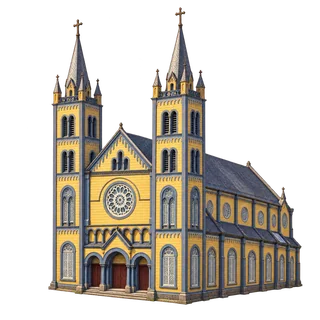
This cathedral-basilica in Paramaribo wears colours chosen to resemble stone, yet its structure is wooden. Construction began in 1883, and the church was blessed in 1885; the tall wooden spires followed around 1901. Look below them for the central rose window and the rhythm of arched openings. The diocese describes a building made with Surinamese timber and craftsmanship. After serious decay and a long restoration, it reopened in 2010. Its survival tells a story of people caring for a shared landmark.