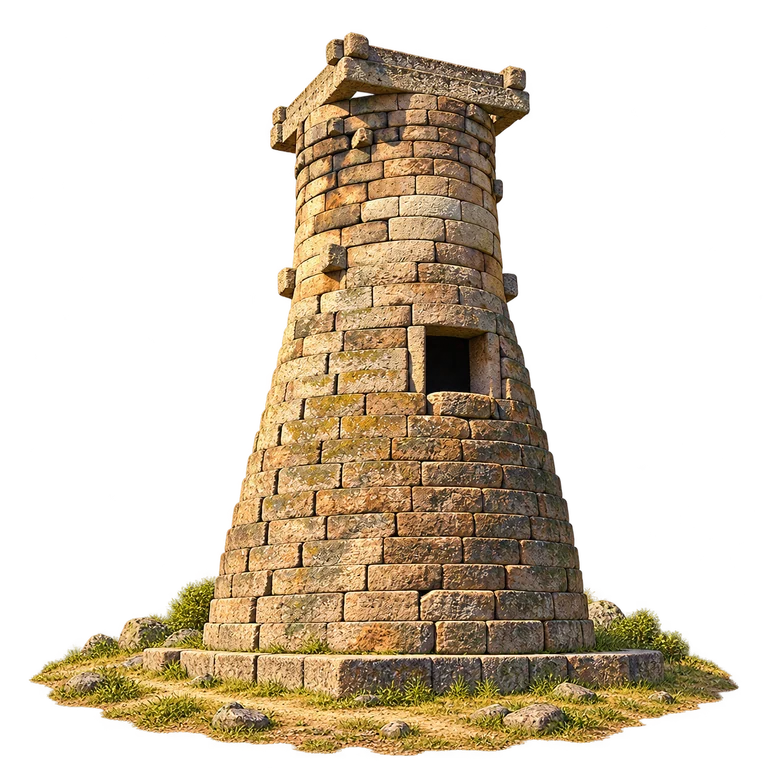
Cheomseongdae is traditionally dated to Queen Seondeok’s reign in the seventh century and is presented by Korea’s tourism authority as an astronomical observatory. Its compact form is more modest than a modern observatory: a curved stone tower about nine metres high, a small opening and a square arrangement of stones at the top.
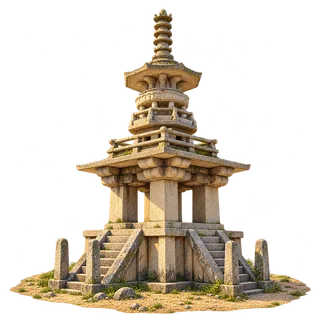
Dabotap stands in Bulguksa’s courtyard opposite the simpler Seokgatap. The Korean heritage account identifies it as an eighth-century stone pagoda, with an unusually elaborate design. Square stairs and posts support changing geometric forms above, making solid granite appear almost like timber construction. Its name is associated with Many Treasures in Buddhist tradition.
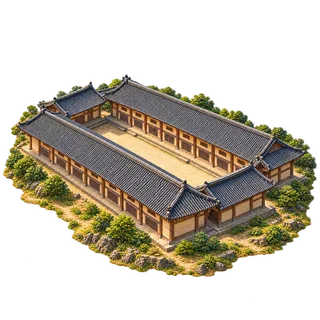
The Janggyeong Panjeon buildings at Haeinsa were designed to protect the Tripitaka Koreana woodblocks. UNESCO describes two long halls and two smaller buildings arranged around a courtyard. The fifteenth-century depositories use ventilation and their relationship to local conditions to moderate temperature and humidity. Their purpose joins architecture with the care of texts carved in the thirteenth century.
Four fingers and a bent thumb reach above the water, with streaks of green patina across the palm. This offshore right hand is one half of the Hands of Harmony pair. Its partner stands on land, while this sculpture makes the meeting of artwork and sea impossible to miss.
Hwaseong at Suwon dates to the late eighteenth century under King Jeongjo. Its defences combine developments associated with East Asian and European military engineering. Nearly six kilometres of walls link gates, bastions and artillery towers, making the relationships between structures as important as any single building.
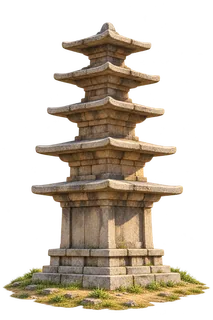
This granite pagoda survives at Jeongnimsa, a temple site associated with the Baekje kingdom’s capital at Buyeo. Its broad lower body and thin projecting roof stones translate the rhythm of timber buildings into stone. Each storey becomes smaller as the tower rises. The surrounding temple has changed, but the pagoda lets visitors study a surviving architectural form from Baekje’s Buddhist heritage.
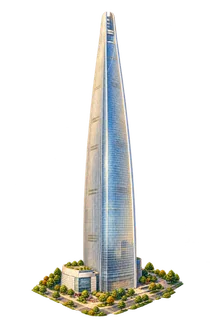
Lotte World Tower gathers a great deal of city life into one tall, narrowing form. Near its top, Seoul Sky offers observation spaces far above the streets. The exterior’s pale vertical lines draw the eye upward, ending at the distinctive opening in the crown. From below, the building is a landmark to navigate by; from its observation floors, the surrounding city becomes the view.
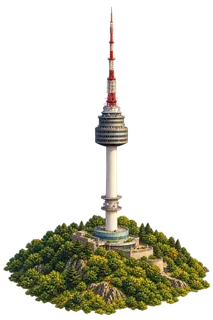
N Seoul Tower began as broadcasting infrastructure on Namsan. Its narrow concrete shaft lifts circular observation decks above the wooded hill, while the antenna continues higher still. The structure brings two ways of connecting a city together: transmitting signals across it and inviting people to look out over it. Look for the contrast between the slim shaft and the broad, dark band of windows near its top.
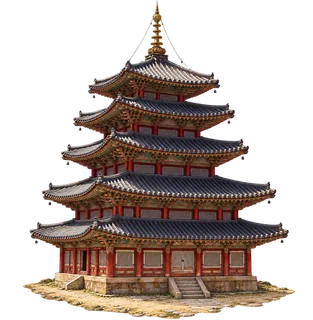
Count the roofs as they become smaller towards the slender finial. Palsangjeon is a rare wooden pagoda, its red columns and painted brackets carrying a rhythm very different from a stone tower. The present building reflects rebuilding and careful conservation across generations.
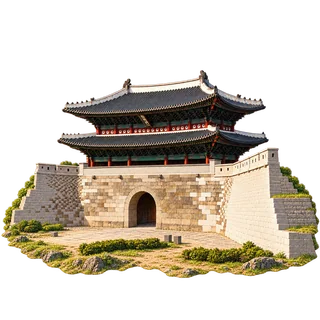
Sungnyemun, also known as Namdaemun, is one of Seoul’s historic city gates. A stone platform and arched passage support its richly coloured timber pavilion. The current exterior also tells a modern restoration story: fire destroyed much of the gate in 2008, and it reopened after reconstruction in May 2013.
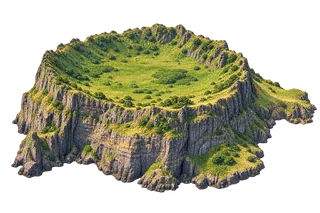
Seongsan Ilchulbong is one of the volcanic features included in Jeju’s World Heritage property. Its tuff cone records an eruption in which magma interacted with water, leaving layered material around a broad crater. The grassy hollow and steep outer walls now give the landform a striking profile. Look past the greenery to the layers: they are part of the evidence for how this place formed.
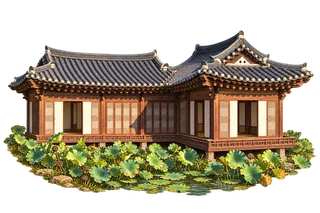
Look where the veranda reaches towards the leaves. Hwallaejeong is a named pavilion within the historic Seongyojang residence in Gangneung. Its low roofline, sliding screens and open edge make the pond part of the experience, giving a quieter view of traditional Korean architecture.