Singapore’s former Supreme Court opened in 1939. Its dome, columns and sculpted facade were designed for a courthouse in the colonial city. After the courts moved away, the building found a different public purpose: it became part of National Gallery Singapore, together with neighbouring City Hall. The change invites a second look at the same architecture, from a setting for legal authority to a place for encountering art.
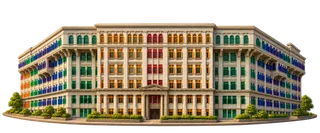
Old Hill Street Police Station has a formal, repeated architectural rhythm: rows of windows, pale walls and a long frontage. Its coloured shutters transform that repetition into one of Singapore’s most recognisable civic facades. The former police building has since been adapted for government offices. Look for how the colours travel across the building, giving a large institutional structure a surprisingly playful presence.
Established in 1859, Singapore Botanic Gardens developed from a colonial landscape garden into a centre for research, conservation and education. Its history includes the study and distribution of rubber plants across Southeast Asia. Plant collections, landscape design and historic buildings together tell the story of this evolving scientific institution.
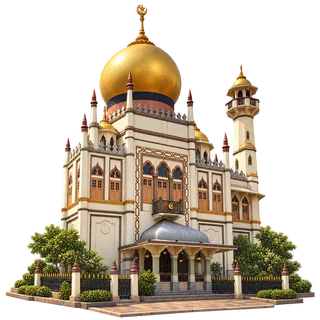
Sultan Mosque is an important place of worship in Singapore’s Kampong Gelam neighbourhood. Its origins reach back to the nineteenth century, while the familiar domed building belongs to a later chapter. Beneath the great dome, a band incorporates glass bottle ends contributed by members of the community. Those small repeated pieces bring a human scale to an imposing landmark: a reminder that a building’s story can include many kinds of contribution.
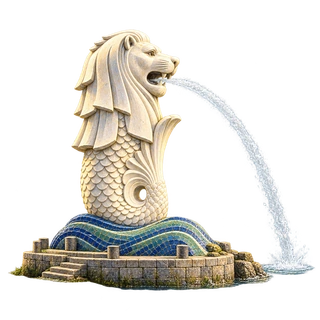
Singapore’s Merlion brings two stories together: the lion recalls Singapura, while the fish remembers the settlement’s fishing roots. The original statue was unveiled in 1972 and later moved to this waterfront park.
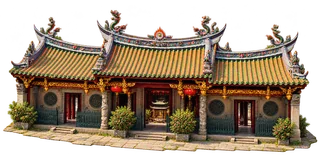
Thian Hock Keng connects Singapore’s Chinese community with the maritime journeys of earlier migrants. Dedicated to Mazu, a deity associated with protection at sea, it remains a place of worship. Its southern Chinese architectural traditions appear in curved roof ridges, decorative creatures and carefully worked materials. The entrance hall offers a first encounter with those details before the courtyards and further halls beyond.