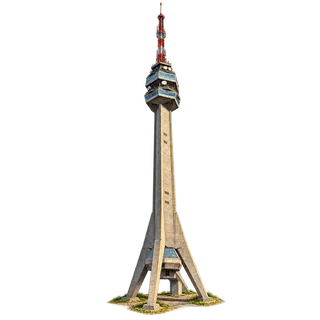
Avala Tower serves broadcasting as well as visitors looking across the Belgrade region. The current tower rises 204.68 metres, with lifts carrying visitors to its viewing level. Its splayed concrete legs and angular glazed upper structure make the engineering visible from the ground.
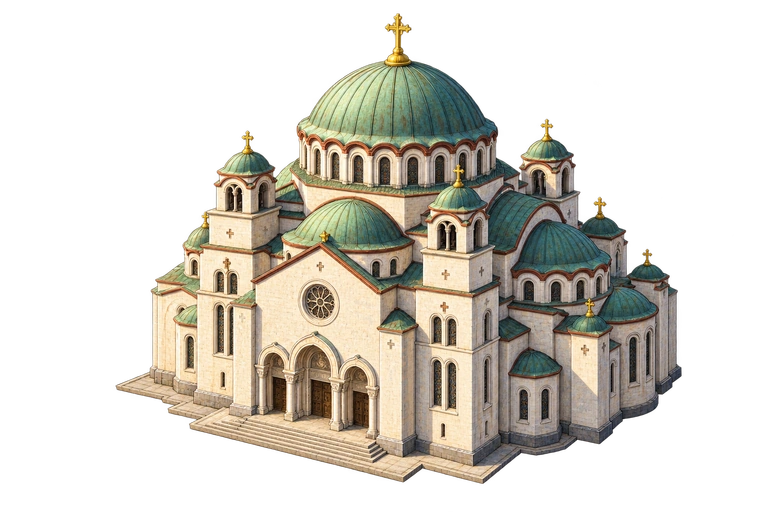
On Belgrade’s Vračar plateau, the Church of Saint Sava gathers a broad building beneath a great central dome. Its official architectural account describes a Greek-cross plan, with the main dome above the central worship space. The church’s published axes measure ninety-one metres east to west and eighty-one metres north to south; the exterior reaches seventy-nine metres including the cross. Smaller domes, curved apses and arched entrances give the pale stone exterior its layered silhouette. The painting concentrates on the church itself, leaving the surrounding park and city outside the scene.
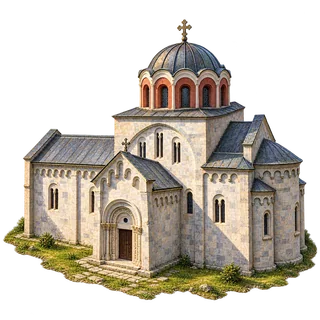
Stefan Nemanja founded Studenica in the late twelfth century. Its Church of the Virgin brings together a domed Byzantine plan and Romanesque stone decoration. The marble exterior and the frescoes protected inside make the church central to the monastery’s artistic history.
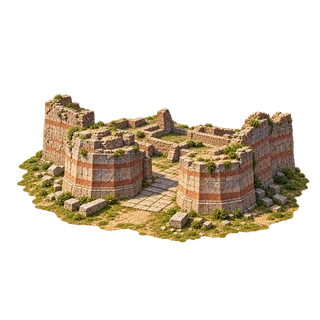
Galerius commissioned Gamzigrad-Romuliana in the late third and early fourth centuries. The complex included a fortified palace, temples, baths and a memorial area. Its name, Felix Romuliana, honoured the emperor's mother. The surviving ensemble brings domestic, ceremonial and commemorative architecture into one archaeological landscape.
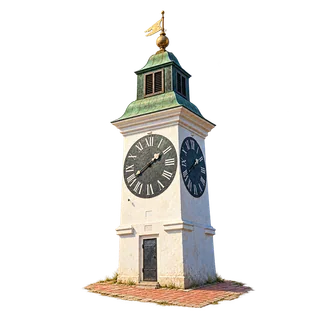
The clock tower is a familiar symbol of Petrovaradin Fortress and Novi Sad. Its large hand marks the hours and the smaller hand the minutes, making the hour easier to read from a distance. Clock faces look out in four directions above the Upper Town.
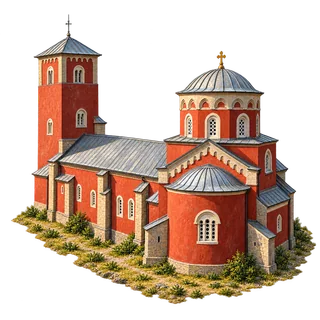
Early thirteenth-century Žiča became a seat of Serbia’s archbishopric and a coronation site for its rulers. The Church of the Ascension’s facades were originally painted bright red, setting off its pale decorative details. Damage and restoration are part of the present building’s history, while its dome and western tower still define the monastery’s outline.