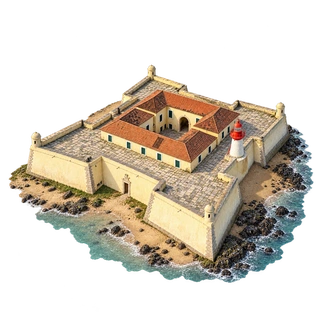
Fort São Sebastião was erected by Portuguese forces in 1575 and was later rebuilt and enlarged. It now houses São Tomé's National Museum. The building's changing use connects a structure created for colonial defence with the later work of preserving and interpreting the archipelago's history.
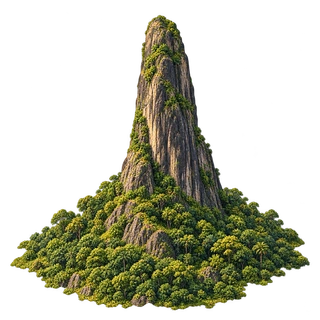
Pico Cão Grande is one of southern São Tomé’s most striking natural landmarks. Its narrow volcanic rock tower stands out sharply from the surrounding canopy.
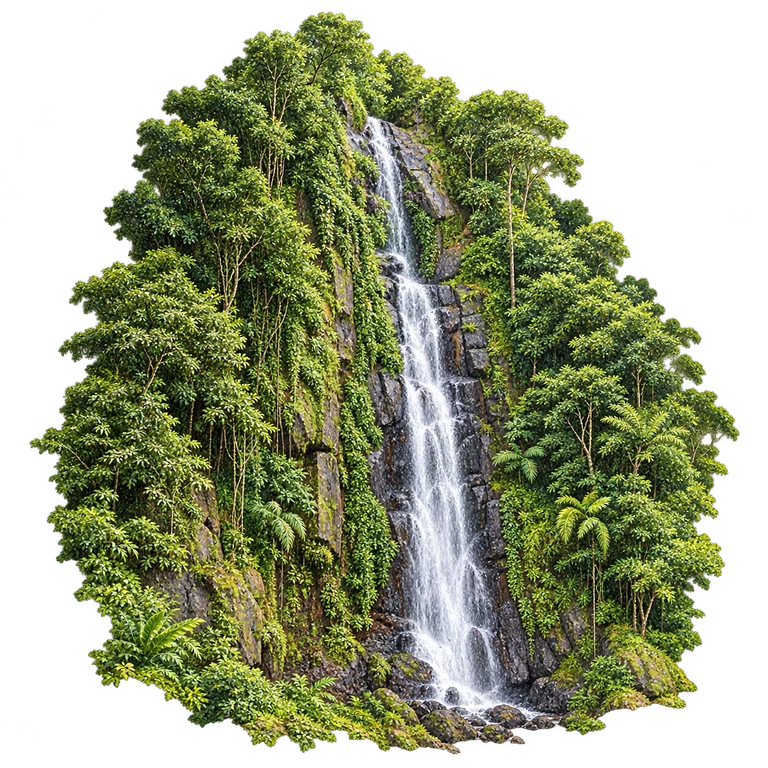
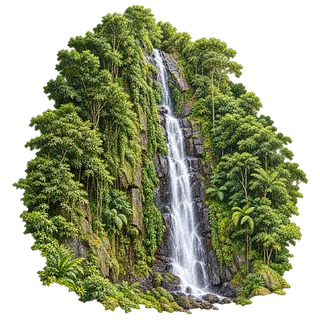
São Nicolau Waterfall is one of the natural places highlighted by São Tomé and Príncipe’s tourism authority. The cascade runs down a steep rock face among ferns, vines and dense vegetation. Photographs show how the flow can change: sometimes a broad white fall, sometimes thinner streams tracing the dark stone. Look for the contrast between the moving water and the green plants rooted beside it.
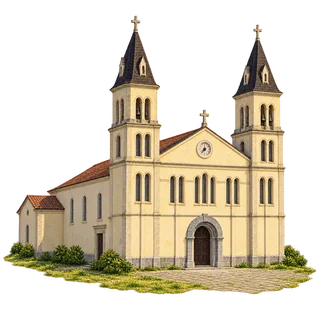
The Cathedral of Our Lady of Grace is a landmark in São Tomé’s historic centre, near the Presidential Palace. The national tourism authority includes it among the city’s cultural places. Its paired towers and dark pointed roofs stand above a restrained pale facade. Look more closely at the central gable and the stone-edged arched entrance: different shapes repeat across a building that remains a place of worship.
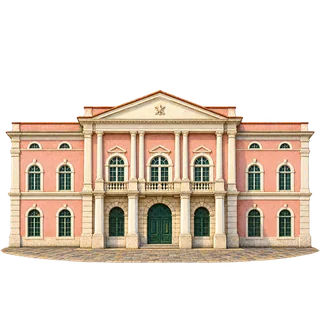
São Tomé’s Presidential Palace is also known as the Palácio do Povo, or People’s Palace. The national tourism authority identifies it among the landmarks of the capital’s historic centre. Its symmetrical frontage brings together pale pink walls, white classical details and tall green openings. Compare the central pediment with the rounded arches below: a compact lesson in the different shapes that make a building’s outline distinctive.
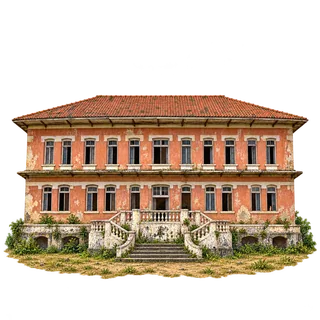
Roça Agostinho Neto was a colonial cocoa plantation, formerly known as Rio do Ouro. Its old hospital stands above an approach through the settlement. The surviving front combines long rows of windows with a broad staircase and worn balustrades. These buildings belong to the history of the plantation system and the people who lived and worked within it. Their grand forms should be read alongside that unequal colonial past, rather than as a complete account of life on a roça.