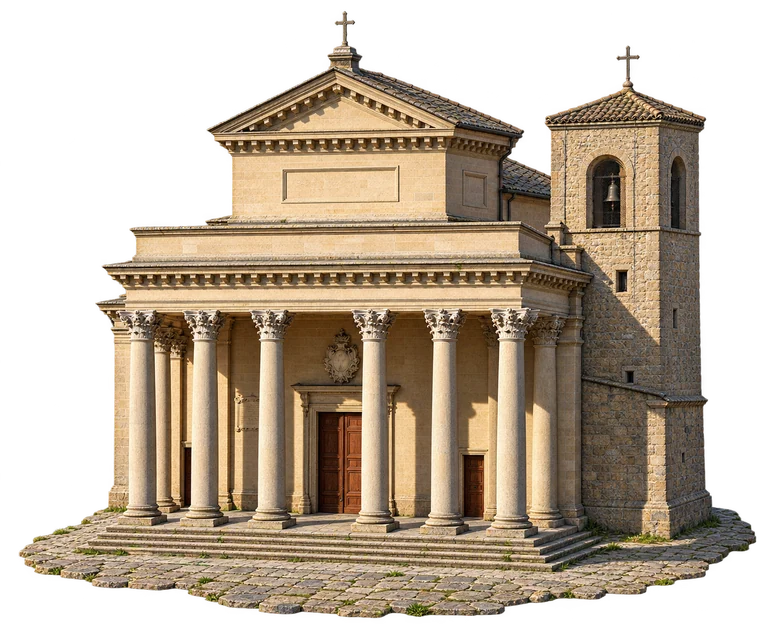
The Basilica of Saint Marinus stands in San Marino’s historic centre. Its neoclassical entrance has a broad staircase and a Corinthian portico, while the older stone bell tower rises beside it. Construction of the present basilica began in 1826. Look for the contrast between the pale classical frontage and the rougher stone of the tower.
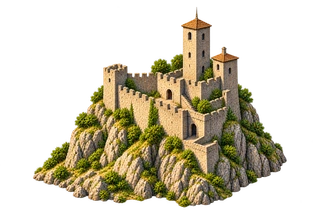
Guaita is the oldest of San Marino's three towers. Its defensive complex has outer and inner walls, with towers and buildings sheltered inside. The name is associated with keeping watch: from this rocky position, the fortress overlooks the surrounding land. Its form reflects repeated enlargement and restoration rather than a single untouched building campaign.
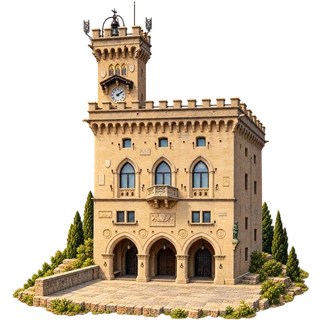
San Marino's Palazzo Pubblico stands in Piazza della Libertà on the site of an earlier communal palace. Built between 1884 and 1894 to Francesco Azzurri's design, it draws on medieval Italian civic architecture. The building houses principal state institutions and provides a setting for official ceremonies.
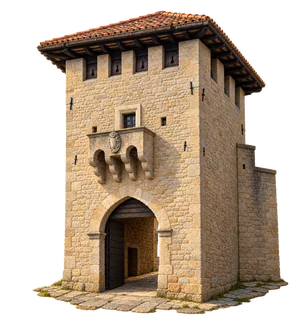
Porta San Francesco is an entrance to the fortified historic centre of San Marino. A small projecting balcony and carved crest sit above the arched passage. Higher up, narrow openings punctuate the stone walls beneath a low tiled roof. The small gatehouse offers a different silhouette from the republic’s tall ridge-top towers.
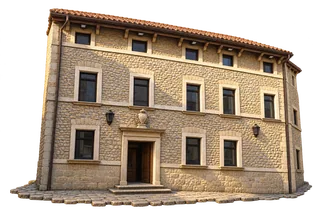
San Marino’s State Museum occupies Palazzo Pergami Belluzzi in Piazzetta del Titano. Its collections bring together archaeology, art and coins connected with the republic and donations from elsewhere. This view shows the museum’s entrance frontage: a dressed-stone doorway and carved crest contrast with rough walling and rows of dark rectangular windows.
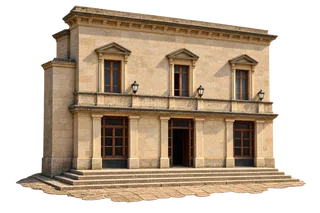
Teatro Titano stands in Piazza Sant’Agata in San Marino. The theatre dates from about 1750 and was restored in 1941 by Gino Zani. Look for the three small window pediments, the horizontal stone ledge and the steps leading to the central door.