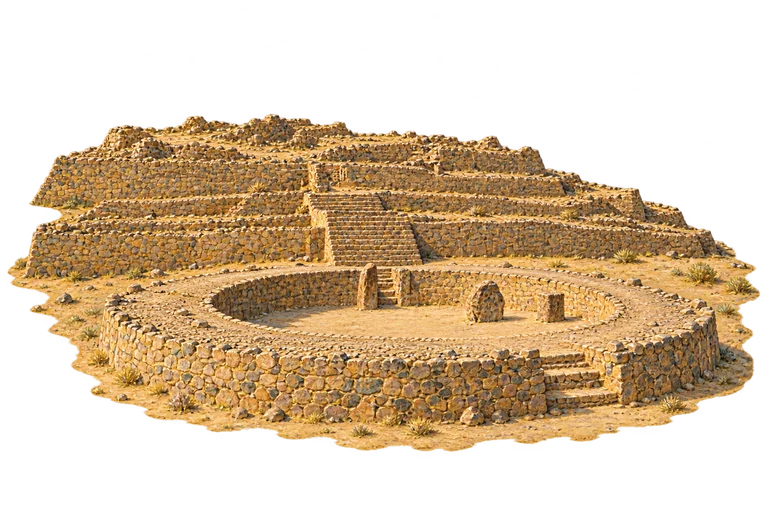
In the dry Supe Valley, Caral preserves evidence of early urban life on the Andean coast. The Pirámide Mayor stands in the upper sector of the city and combines a stepped monumental building with a sunken circular plaza. Its architecture organised movement between open gathering space and elevated rooms. The surviving masonry helps archaeologists study how public buildings were repeatedly shaped and used. Caral’s story reaches far earlier than the Inca Empire, inviting a wider view of the many societies that made the Andes their home.
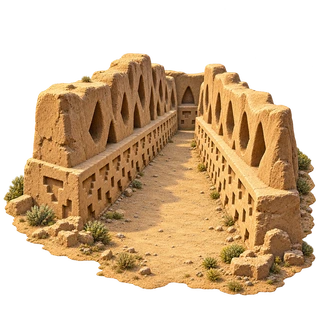
Chan Chan was the capital of the Chimú kingdom on Peru's northern coast. Its urban plan divided the city into large, self-contained palace compounds. The remains preserve evidence of political organisation and monumental building before the kingdom fell to the Incas in the fifteenth century.
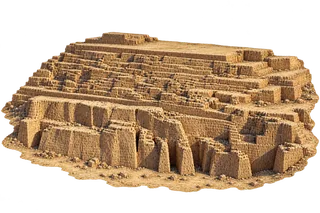
The bricks look almost like books standing on a shelf. At Huaca Pucllana, layers of adobe rise above Miraflores, preserving a ceremonial centre of the Lima culture. Follow the worn terraces and exposed walls to see how a vast structure was built from many small pieces.
Huascarán is a landmark of the Cordillera Blanca in Peru’s Áncash region. Its northern and southern summits form a connected high massif, with the southern summit the higher of the two. Snow, glacier ice and exposed rock shape its broad profile. This mountain is distinct from the steep green peak beside Machu Picchu.
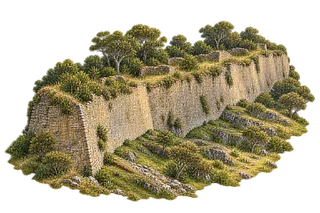
Kuélap was a centre of political, administrative and religious life for Chachapoya communities in northern Peru. Its monumental limestone walls supported a settlement high in the mountains. The outer masonry is part of a living conservation challenge: sections have needed stabilisation and careful recovery after damage. Looking at the surviving wall brings attention to fitted stone, height and the relationship between settlement and hillside. This is a place to explore Chachapoya history on its own terms, rather than treating every Andean monument as Inca.
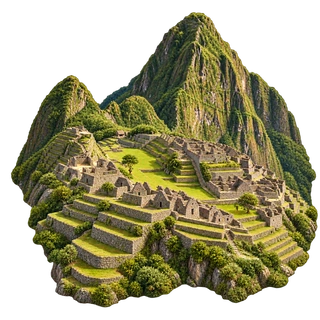
The Inca built Machu Picchu in the fifteenth century. Its urban and agricultural areas include around 200 structures, with terraces and stone walls following the ridge. A large square separates parts of the settlement, while the green mountain setting gives the citadel its remarkable silhouette.
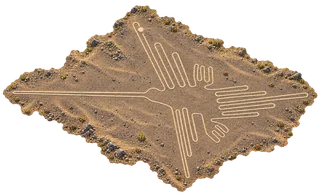
Look closely at the pale line: it forms a bird without ever becoming a solid painted shape. The Hummingbird belongs to the famous Nasca geoglyphs, made by clearing darker surface stones to reveal lighter ground. Its purpose remains debated, but its elegant outline is unmistakable from above.
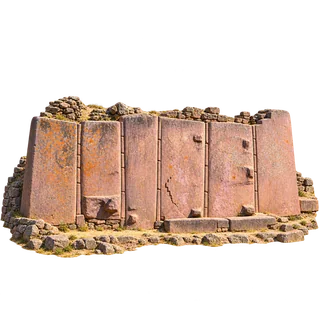
The Sun Temple at Ollantaytambo includes a remarkable wall made from six upright monoliths. Narrow filler stones join the large pinkish slabs. The surrounding temple remained unfinished. Look at the different slab widths, uneven top edges and small details left on the stone faces.
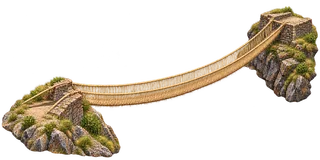
Look for the thick ropes beneath the walkway and the thinner ties along its sides. Q’eswachaka is sustained by a tradition of community renewal: local families prepare fibres and work together to rebuild the crossing. UNESCO recognizes the knowledge, skills and rituals behind this living practice, rather than treating its ropes as an unchanged ancient object.
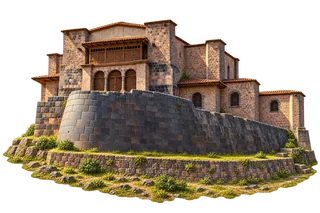
Qorikancha was a major Inca sacred complex connected with Inti, the Sun. Spanish colonisation transformed the place, and the Convent of Santo Domingo was built over its structures. The contrast remains visible in the carefully fitted dark stone of the curved lower wall and the later masonry above. Neither layer tells the whole story by itself. Looking closely at their meeting makes Cusco’s history tangible: sacred use, conquest, adaptation and survival can occupy the same small part of a city.
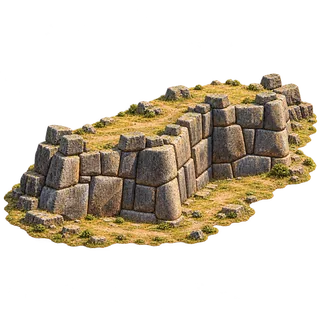
Sacsayhuamán stands above Cusco and preserves monumental Inca stonework. Its outer walls change direction in a zigzag. Large irregular stones fit closely together, creating a different pattern from regular brick courses. This small wall section represents part of the surviving masonry, not the entire archaeological park.
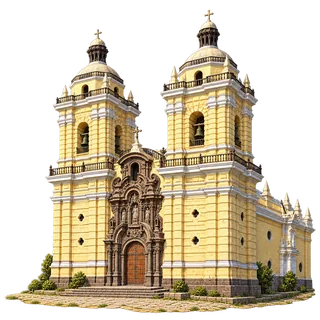
San Francisco is part of a Franciscan religious complex in Lima’s historic centre. Its frontage contrasts pale-yellow towers with a dark carved stone portal. The larger complex also contains cloisters, a library and catacombs. This view focuses on the main church’s two towers and entrance, rather than its neighbouring churches.
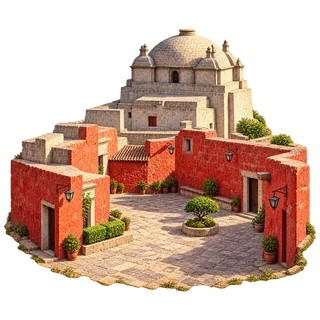
Santa Catalina was founded in Arequipa in 1579. Its history is closely connected with a community of women and the architecture they inhabited over generations. Inside the monastery, passageways and courts create intimate spaces rather than one single monumental facade. Coloured walls contrast with the city’s pale sillar stone, while doorways, lamps and planting give each corner a distinct character. A quiet courtyard offers a way to notice this layered place without imagining a ceremony or intruding on the lives of its religious community.