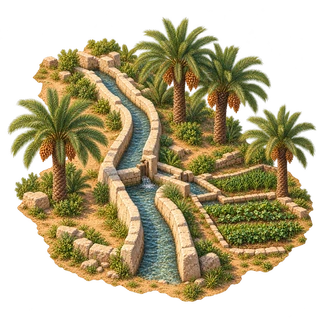
Oman's aflaj bring water from springs, groundwater or surface sources through carefully planned channels. Gravity drives the flow, while communities divide access through established sharing arrangements. Falaj Daris is one of five systems in the World Heritage property, linking water engineering with the cultivation and everyday life it supports.
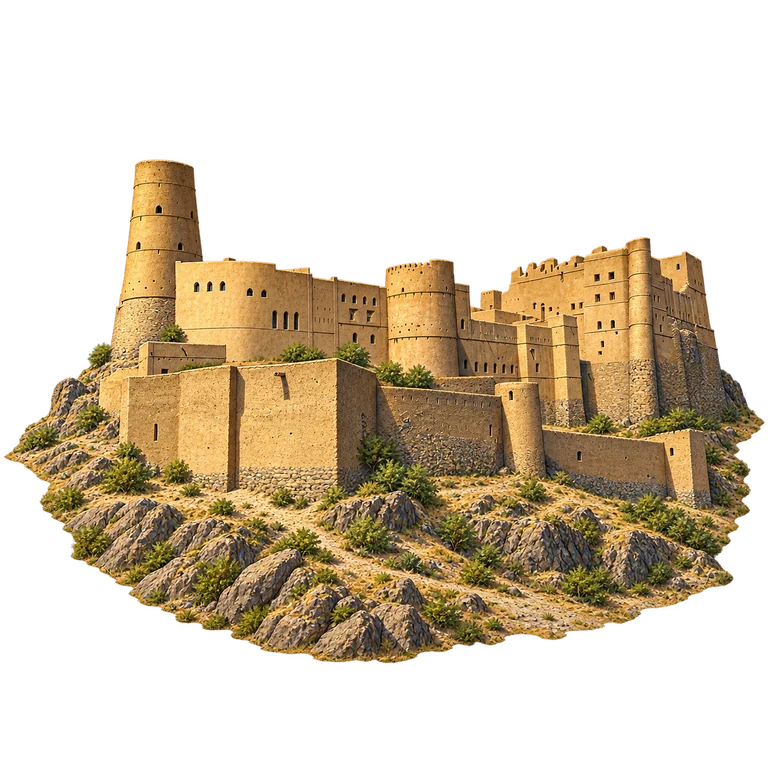
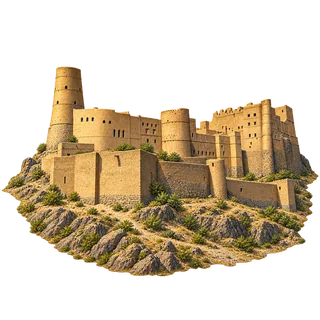
Bahla’s fort belongs to an oasis shaped by the Banu Nebhan, influential in the region from the twelfth to the fifteenth century. UNESCO describes its unbaked-brick walls and towers rising from stone foundations. Different heights and irregular blocks show a fortress adapted and extended over time, rather than a single symmetrical design. Conservation of such a place involves both its imposing outline and vulnerable earthen fabric. The surrounding oasis gives the fort a wider social and environmental setting.
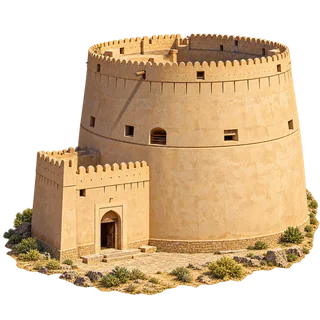
Nizwa’s great round tower was built during the seventeenth-century rule of Imam Sultan bin Saif Al-Ya’rubi. Oman’s tourism account describes a structure about 45 metres across and 34 metres high. Its thick stone-and-sarooj construction and carefully controlled openings reveal a defensive design, while the fort also served local government and residence. The tower’s broad circular form distinguishes it from the smaller gateways and buildings around it. Architecture here joined protection with the administration of a town.
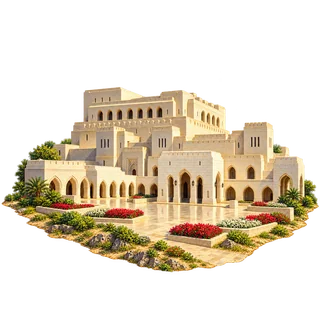
The Royal Opera House Muscat presents music and performing arts from Oman, the region and beyond. Its own account describes cultural exchange and educational programmes as central to its role. The main hall’s broad pale-stone masses and arched entrance relate contemporary performance architecture to Omani forms. The building is therefore more than an ornamental frontage: it supports a programme of listening, learning and artistic collaboration. The public exterior gives a first impression of that shared cultural space.
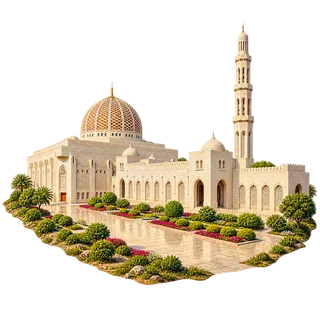
Sultan Qaboos Grand Mosque opened in 2001. Its main prayer hall, arcades, gardens and minarets create one of Muscat’s major religious places. The dome’s open geometric pattern contrasts with the weight of the pale stone walls, while repeated arches link the hall with the court. This remains a living mosque, where architecture serves worship and learning. Its public exterior offers a way to notice craftsmanship while respecting the purpose of the place.