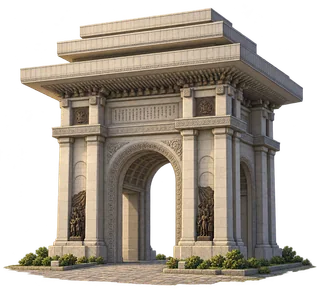
Pyongyang’s Arch of Triumph was erected in 1982 as a state monument commemorating the end of Japanese colonial rule. The broad granite piers and projecting cornices give it a distinctive outline. Look through the great main arch, then towards the side passage and the shallow stepped levels above.
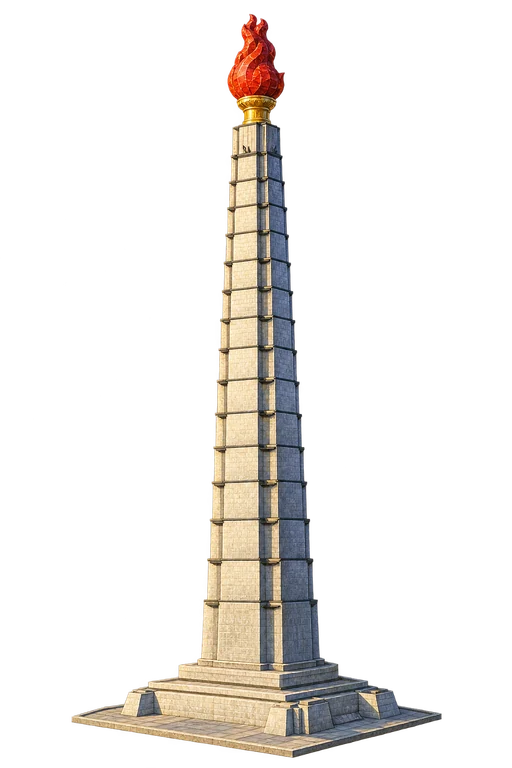
Juche Tower was completed in 1982 and takes its name from North Korea’s state ideology. The structure is a major landmark of Pyongyang. Its tapered stone shaft is capped by a sculpted torch, which is illuminated at night. Look for the repeated horizontal joints and the stepped base beneath the narrow tower.
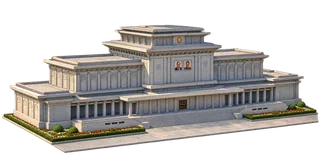
Kumsusan Palace in Pyongyang serves as the state mausoleum of Kim Il Sung and Kim Jong Il. The building’s formal architecture uses repeated stone bays, broad cornices and a symmetrical central block. Look at how the low entrance colonnade links the taller sections behind it. The miniature focuses on the building’s main front rather than the whole estate.
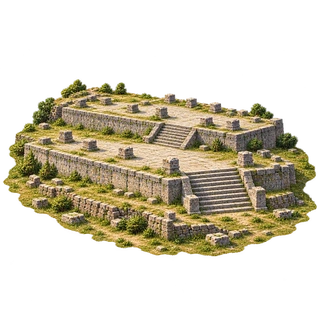
Manwoldae's palace archaeology forms part of the historic monuments of Kaesong. Together with remains of an astronomical and meteorological observatory, it records the Koryo dynasty's capital. The wider ensemble includes schools, city defences and commemorative places, revealing how planning connected government, learning and spiritual beliefs.
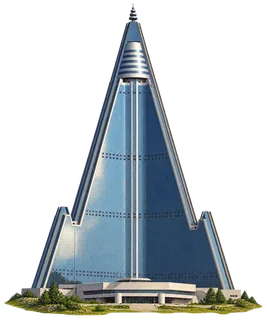
The Ryugyong is an unusually shaped high-rise building in Pyongyang. Its three-wing form creates long sloping edges, with a projecting conical element high above the ground. The glass cladding reflects the sky in a fine grid. Look for the small ringed elements at the building’s narrow crown.