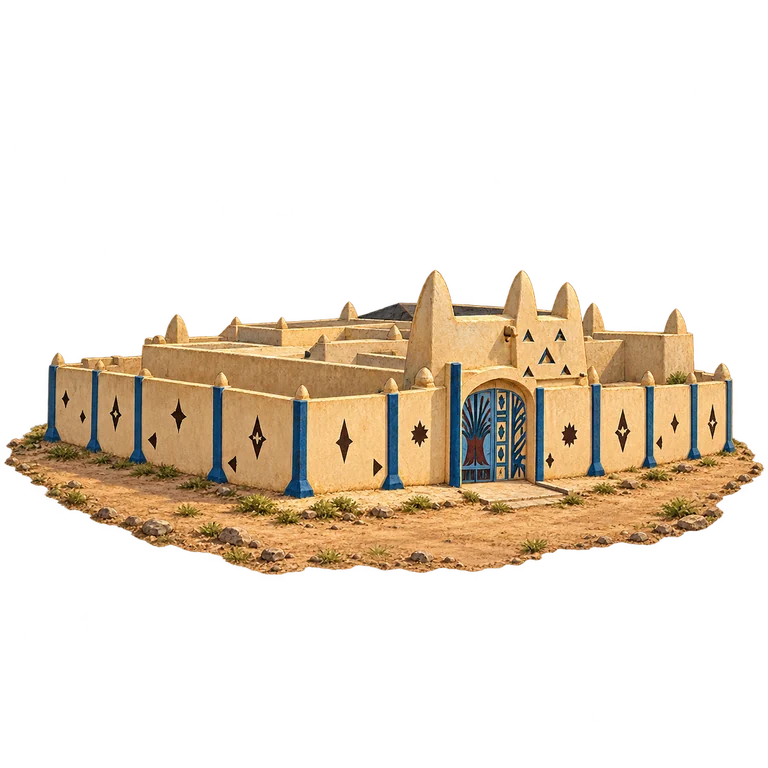
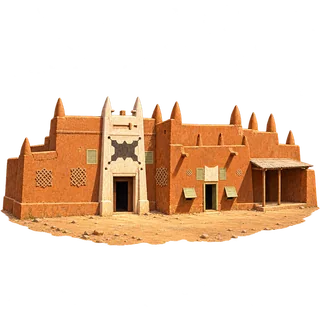
The Palais du Zarmakoye occupies a significant place in Dosso’s civic and cultural history. The state’s heritage nomination dates the palace to 1904 and links it to Zarmakoye Abdou Aoûta. The photographed entrance has pale walls, blue accents and a patterned gate, bringing a vivid rhythm to a low frontage. Its present decorative treatment should not be mistaken for an unchanged photograph of the building’s earliest years.
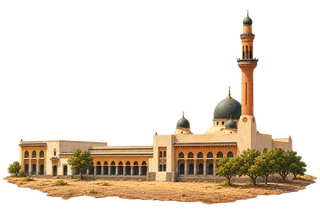
Start with the broad prayer-hall frontage, where repeated arches create a shaded rhythm below the roof. The rounded domes sit close to this low building, while the single tall minaret draws the eye upward. This is the Grand Mosque of Niamey, a place of collective worship in Niger’s capital. Its balance of long horizontal arcades and one narrow vertical tower gives the exterior a recognisable silhouette.
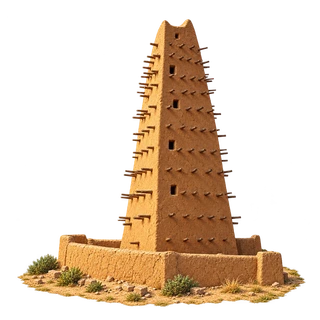
Agadez grew as a caravan-trade crossroads on the Sahara's southern edge. Its historic street pattern reflects the boundaries of earlier encampments. Earthen homes, palatial buildings and religious architecture fill irregular quarters, while the tall mud-brick minaret remains a distinctive feature of the townscape.
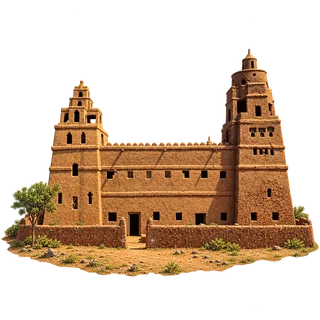
Yaama Mosque grew through the work of its community and builder El Hadji Falké Barmou. The Aga Khan Award account describes a mud-brick prayer hall later developed with a central dome and four individual corner towers. The two front towers shown here have different sculptural profiles, making the facade especially distinctive. Cyclical care of the earth-built fabric is part of the building’s continuing story.
Zinder’s old Birni quarter grew around the Sultanate of Damagaram. The state’s heritage nomination describes the palace as a place of customary authority and a continuing responsibility for care. Its entrance combines warm earthen walls, raised geometric decoration and a distinctive light-coloured portal. These surfaces invite a closer look at Hausa building traditions, rather than an imagined glimpse of ceremonies inside.