earth
Atlas Mountains
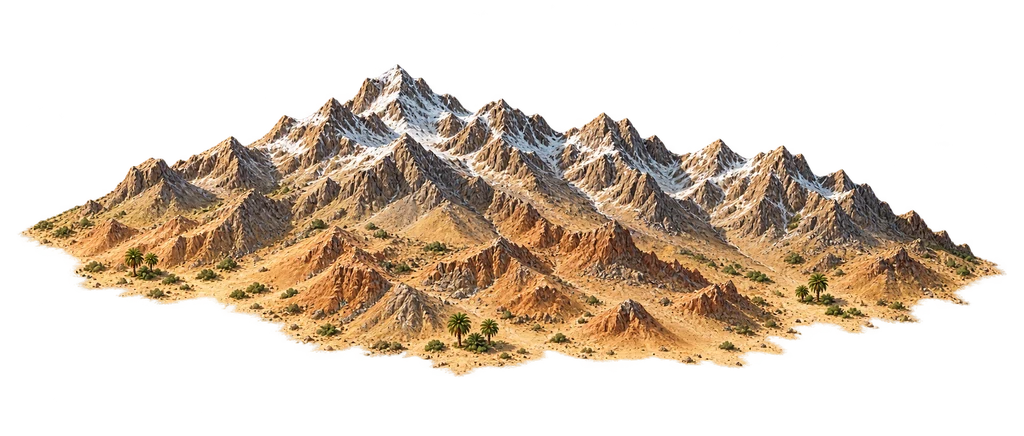
The Atlas Mountains extend across northwestern Africa. Their high ridges, dry plateaus and valleys form a varied mountain landscape.
Source: Wikidata
Northern Africa
Discover Atlas Mountains, Bab Mansour, Bahia Palace’s Grand Courtyard and more.
Explore 12 illustrated places, read the stories behind them and look closer on the globe.
Explore Morocco on the globe →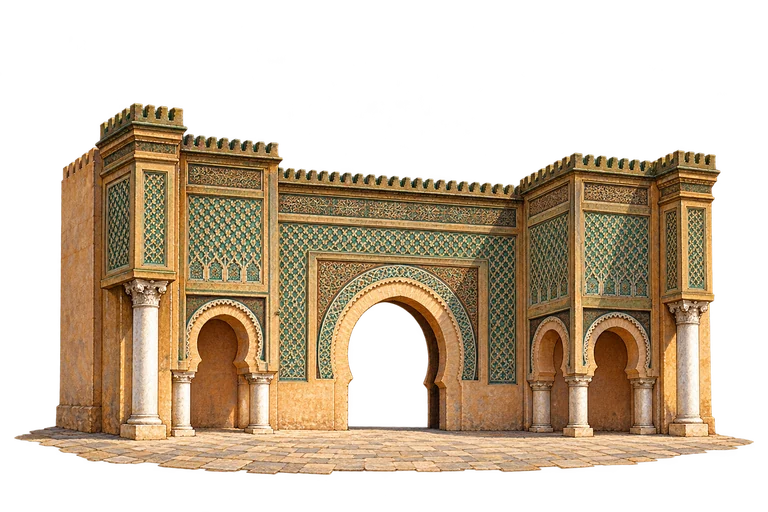
earth
The Atlas Mountains extend across northwestern Africa. Their high ridges, dry plateaus and valleys form a varied mountain landscape.
Source: Wikidata
architecture
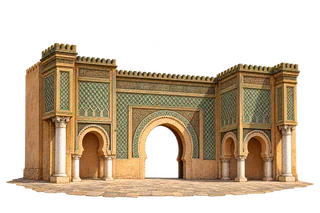
Bab Mansour faces Place El Hedime in Meknes. Morocco’s national tourism office highlights it as a major example of Hispano-Moorish art. Look for the large central horseshoe arch, the smaller side niches and the pale columns beneath patterned panels. Green and cream geometric decoration contrasts with the warmer masonry. The gate forms a distinct architectural threshold within the historic city, rather than a whole fortress or palace.
Source: Moroccan National Tourism Office
architecture
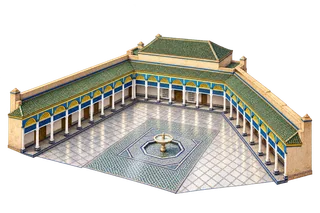
Bahia Palace grew in stages during the second half of the nineteenth century in Marrakech. Rather than one great hall, it brings together courtyards, gardens and richly worked rooms. In the Grand Courtyard, low white columns support brightly painted wooden galleries beneath green tiled roofs. Look down from those colours to the patterned paving and the small fountain. The palace’s combination of marble, zellige tilework, carved wood and plaster records the skill of Moroccan craftspeople, with each court offering a different setting.
Source: Ministère de la Jeunesse, de la Culture et de la Communication
architecture
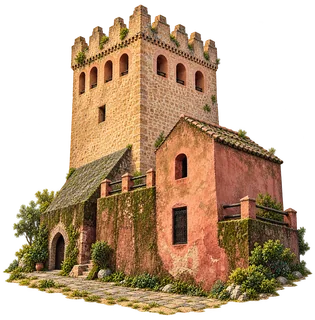
Chefchaouen’s kasbah stands within the city’s old medina, surrounded by gardens. Its warm stone tower provides a contrast to the blue streets for which the city is famous. Look for the upper row of arched openings, the stepped crenellations and the lower entrance building attached to the tower. The kasbah also houses museum collections, including historic photographs and textiles. This component reveals a fortified historic place within a living city of craft and colour.
Source: Moroccan National Tourist Office
architecture
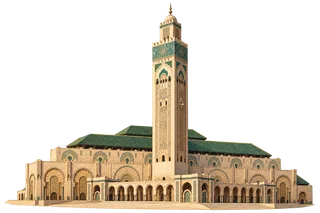
Hassan II Mosque stands on Casablanca’s Atlantic edge. Its foundation describes the collaboration between architect Michel Pinseau and Moroccan master craftspeople who worked in stone, wood, plaster and tile. The mosque opened in 1993. Look for the contrast between the towering square minaret and the low green roofs of the prayer hall. Repeated horseshoe arches and geometric decoration give the broad frontage its rhythm.
Source: Hassan II Mosque Foundation
architecture
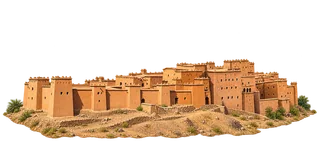
At Ouarzazate, Kasbah Taourirt is part of a larger historic residential quarter. Its linked earthen buildings rise in an irregular pattern of flat roofs, tapering towers and small window openings. Look for the contrast between the broad plain walls and the finer geometric decoration near their tops. This is one example of southern Morocco’s distinctive earthen architecture, and a different place from the nearby ksar of Ait-Ben-Haddou. The surviving frontage reveals homes and passages as well as fortification.
Source: Moroccan National Tourist Office
architecture
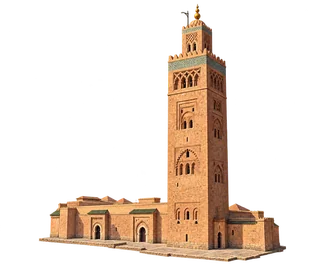
Koutoubia Mosque is one of Marrakech’s best-known monuments. The city’s official guide describes a complex with two successive sanctuaries and a stone minaret. Its decoration combines carved relief with white and green ceramic bands near the top. Look for the smaller lantern above the broad square shaft and the stacked golden finial. The low mosque walls make the tower’s height especially striking.
architecture
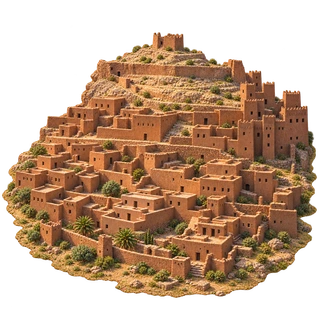
Ait-Ben-Haddou is a ksar, a traditional group of earthen buildings enclosed by defensive walls. Houses stand close together, while corner towers reinforce the settlement's outer edge. The place illustrates the architecture of southern Morocco and the compact building forms of a pre-Saharan habitat.
Source: UNESCO World Heritage Centre
architecture
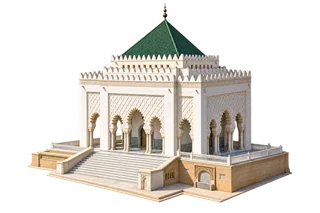
The Mohammed V Mausoleum was built in Rabat between 1962 and 1971. It contains the tombs of Mohammed V and his sons Hassan II and Prince Moulay Abdallah. The compact white building is distinguished by its green tiled roof, scalloped arches and finely worked surfaces. Look at how the roof’s simple shape contrasts with the layers of geometric decoration below. Beside the older Hassan monument, this twentieth-century mausoleum brings another period of Moroccan architecture into the same historic setting.
Source: Visit Rabat
landscape
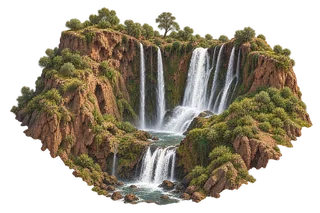
The waterfalls of Ouzoud are one of the best-known natural sights of Morocco’s Azilal region. Several streams descend a steep cliff, with a broad cascade beside narrower ribbons of water and another drop below. Look for the greenery that clings to the damp rock and the foaming water gathered between the ledges. The scene belongs to a living river system: flow and spray change, while the contrast between pale water, dark wet rock and vegetation makes the falls immediately recognisable.
Source: Moroccan National Tourist Office
landscape
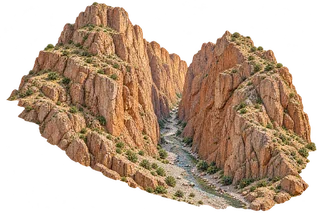
Near Tinghir, the Todra Gorge cuts through the eastern High Atlas landscape. Its steep limestone walls rise above a narrow river passage, creating a striking contrast between massive rock and the small corridor below. Look at the fractures and ledges on the facing cliffs, then follow the water along their base. This is a distinct gorge landscape, rather than the snowy high summits around Toubkal. The enclosing walls reveal scenery shaped by a river’s cut as well as the peaks above.
Source: Moroccan National Tourist Office
architecture
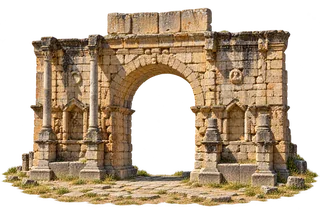
The Arch of Caracalla is a landmark within the archaeological city of Volubilis. UNESCO’s evaluation places it across the decumanus maximus, one of the city’s principal streets. Look through the large round opening, then compare the columns on the two piers and the uneven upper masonry. The surrounding remains record several periods of the city’s history. The arch that stands today includes restoration, while much of its original crowning decoration is lost.
Source: UNESCO / ICOMOS
Read more about Morocco · Choose another country or territory · How to play USURPR