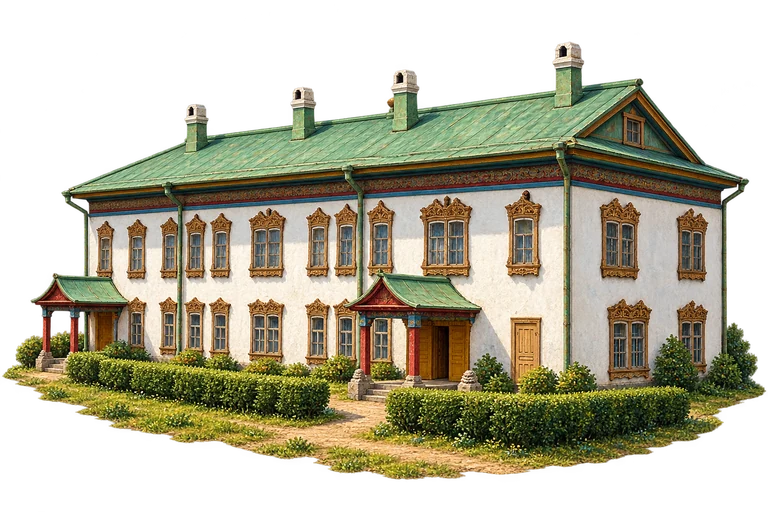
The Winter Palace of the Bogd Khan preserves buildings and collections connected with Mongolia’s last Bogd Khan, a religious leader and ruler. Among the complex’s varied architecture is a white residence with a pitched green roof and decorated window frames. Its appearance differs sharply from the ceremonial temple buildings nearby. The museum setting allows these different forms to be considered together as parts of a complicated period in Mongolian history.
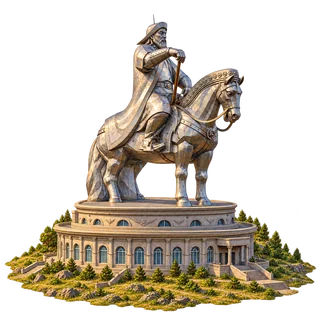
The equestrian statue at Tsonjin Boldog is a modern monument to Chinggis Khaan. Its reflective metal surface and circular base make it very different from an ancient statue or a living horse on the steppe. The complex interprets a historical figure whose empire has a wide and contested legacy. Look at how the horse’s planted stance, the rider’s upright form and the broad base work together to create the monument’s silhouette.
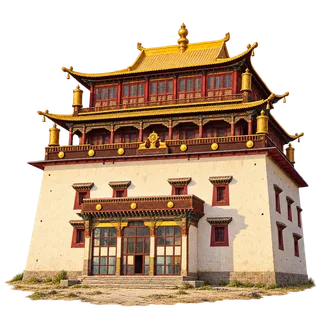
Migjid Janraisig Temple is a distinctive building within Ulaanbaatar’s Gandan monastery complex. A substantial white lower body supports red timber elements and golden roof forms above. Inside is a large image of Janraisig, a figure associated with compassion in Mongolian Buddhism. The exterior offers a way to recognise this particular temple while remembering that Gandan is a living religious community, not simply a collection of historic facades.
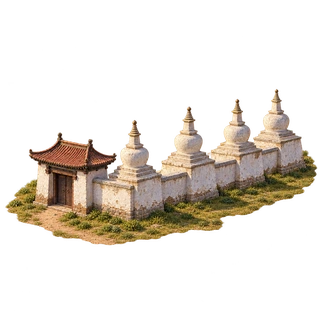
The Orkhon Valley preserves archaeological remains along both banks of its river. They include Kharkhorum, a capital of the Mongol Empire in the thirteenth and fourteenth centuries. Together, settlement and religious sites record relationships between pastoral societies and administrative centres across a long-used Central Asian landscape.
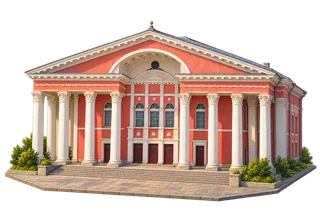
Ulaanbaatar’s State Academic Opera and Ballet Theatre brings Mongolian and international classical performance to the city centre. Its pink facade, white columns and central arched windows give the building a clear identity beside Sukhbaatar Square. It is distinct from the city’s red Drama Theatre. The frontage offers a compact architectural introduction to a place whose most important activity takes place beyond the doors: music, dance and performance.