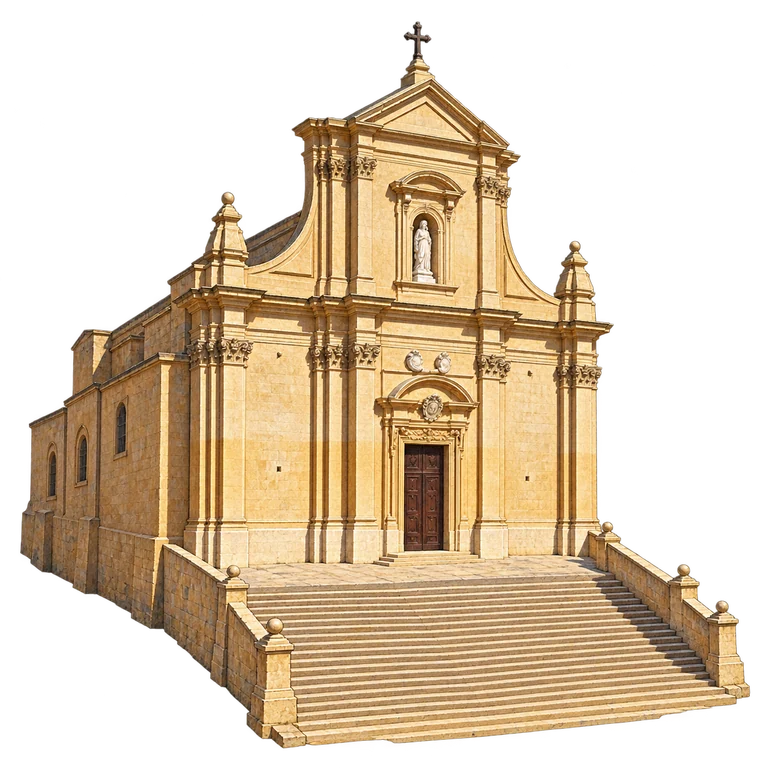
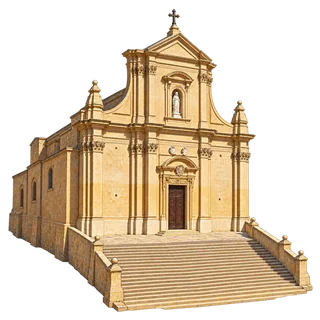
The Cathedral of the Assumption stands within the Cittadella in Victoria, Gozo. Its own history places the church at the centre of a long-lived religious site and describes its role as a cathedral. The exterior is built from warm limestone, with a tall central upper stage and curved shoulders above the entrance. A broad stairway leads towards the door. Look for the niche high in the facade and the triangular pediment above it. The famous illusion of a dome belongs to the painted interior, rather than an exterior dome.
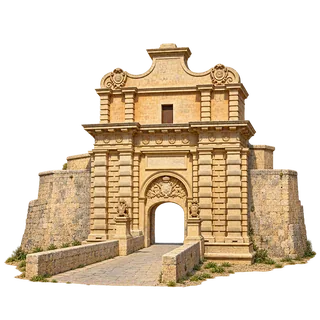
Mdina’s main gate turns a fortified entrance into an architectural statement. Its Baroque frontage combines strongly patterned masonry, a sculpted central emblem and a curved upper parapet. The University of Malta’s repository identifies the Main Gate as a 1724 example of Malta’s limestone architecture. Look through the passage, then upwards from the heavy lower piers to the lighter scrolls above. This is a specific gateway into Mdina, separate from the city’s other entrances and from Valletta’s bastions.
Mosta’s Rotunda is a living church whose broad dome gives it an unmistakable outline. The Mosta Rotunda Foundation presents the dome, church museum, crypt and wartime shelter as different parts of its heritage. Outside, the curved main body meets a straight classical frontage with columns and a triangular pediment. Twin bell towers frame the entrance. Look for the change from repeated vertical columns below to the sweeping curved roof above, all built in the warm tones of Maltese stone.
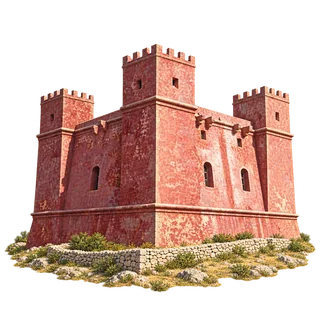
Saint Agatha’s Tower, often called the Red Tower, stands on Marfa Ridge near Mellieħa. The tower’s heritage guide describes its place in Malta’s defensive network and the warning signals once sent towards other towers. Four corner turrets rise above the solid main block, while small openings interrupt the thick walls. Look for the projecting stone supports near the top and the strong horizontal bands below. Its red finish is part of its familiar present appearance; the origins of that colour are less certain.
Valletta was founded in 1566 after the Great Siege of Malta. The Knights of St John and their engineers planned a grid of streets inside bastioned walls, fitting the city to a hilly peninsula between harbours. Its dense urban fabric brings civic, religious and military buildings into close proximity.