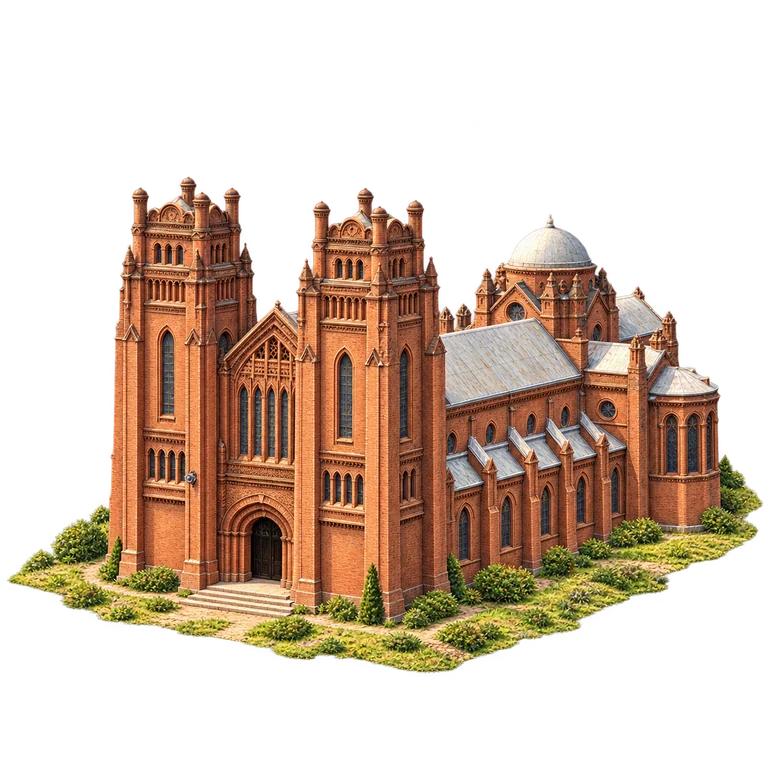
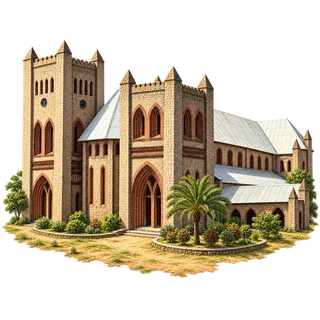
Saint Michael and All Angels stands within the historic Blantyre Mission grounds. Malawi’s High Commission identifies the church as part of the mission established by Scottish missionaries, later associated with the Church of Central Africa Presbyterian. Its red brick is worked into pointed arches, tall towers and small decorative forms. Look from the paired front towers towards the pale roof and dome behind them. The church and the nearby detached mission landmarks are separate structures.
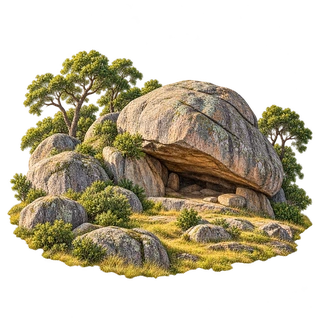
Chongoni's forested granite hills contain rock paintings associated with BaTwa hunter-gatherers and Chewa farming communities. These works record different relationships with the landscape across time. Some symbols remain culturally meaningful to Chewa people, and the area's connections with ceremonies make careful, respectful interpretation essential.
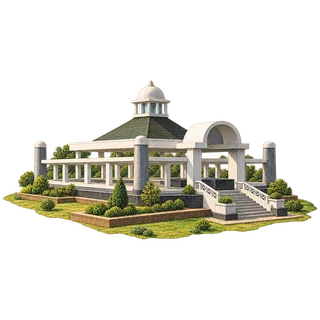
Kamuzu Mausoleum in Lilongwe is the resting place of Hastings Kamuzu Banda, Malawi’s first president. The tourism department describes marble and granite in the memorial. Low horizontal forms, pale pillars and a small cupola give the structure its outline. Look for the open spaces between the supports and the steps approaching the pavilion. A memorial records a person’s place in public history; it need not turn that history into uncomplicated celebration.
Saint Peter’s Cathedral rises on Likoma Island. Malawi’s tourism department identifies it as the principal church of the Anglican Diocese of northern Malawi and notes the use of local granite in its construction. Look for the two square towers, the pointed arches and the pale roofs extending behind them. The building offers a view of the island’s architectural history, beyond the lake scenery for which the region is often known.
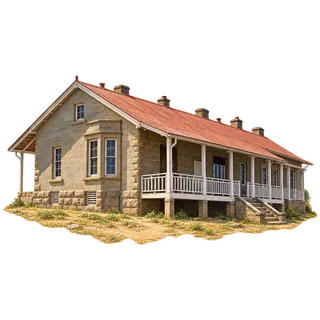
Stone House was once the home of Robert Laws at Livingstonia. Malawi’s tourism department records it as a national monument, while the tourism association describes the museum’s letters, photographs and objects connected with the mission. Look for the long veranda, the simple pitched roof and the contrast between white timber and grey stone. These domestic proportions offer a quieter view of history than a large memorial or cathedral.