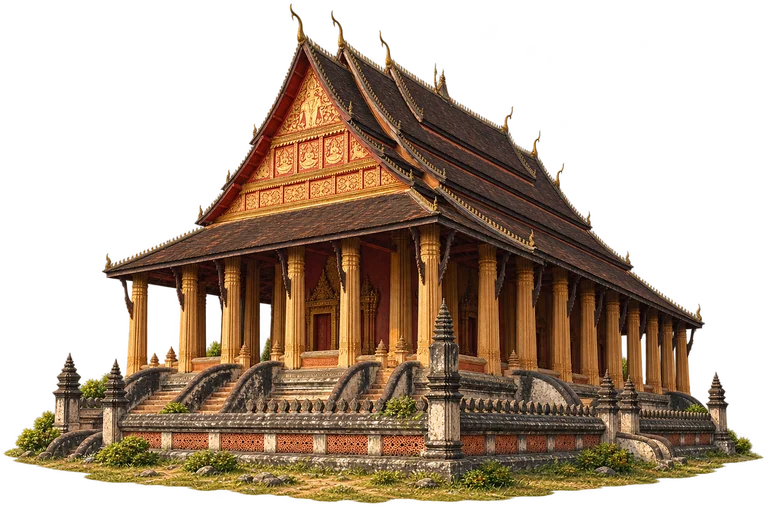
Ho Phra Keo in Vientiane is a former temple that now serves as a museum. Its elevated hall, surrounding columns and elaborate roofline frame collections of Buddhist sculpture, carving and other works of art. The building’s present appearance belongs to a history of rebuilding as well as religious use. Looking at the hall today means encountering both an architectural setting and the objects cared for within it.
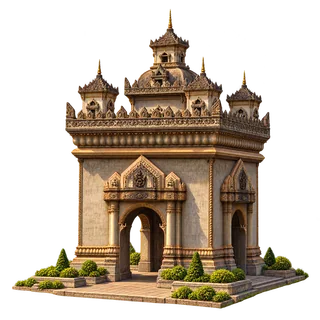
Patuxai is a memorial arch in Vientiane. Its large passages and heavy concrete body are crowned by small pavilions, while Lao decorative forms give the monument its own character. It belongs to the twentieth-century history of the capital and commemorates struggles for independence. Rather than looking only at the openings, follow the building upward to see how the roof pavilions change the outline of the arch.
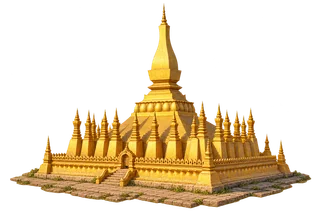
Pha That Luang is a major Buddhist monument in Vientiane. Its high lotus-bud-shaped pinnacle rises from a broad, carefully ordered body with terraces and smaller pinnacles. The monument has been rebuilt and restored through a long history, so its familiar appearance carries more than one period. Its golden appearance also has a useful detail to notice: the tourism authority distinguishes the gilded pinnacle from the painted surfaces below.
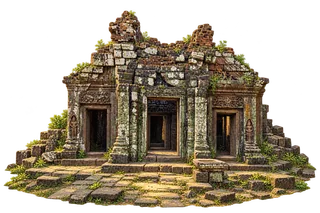
Vat Phou forms part of a historic landscape planned between mountain and river. The upper sanctuary is only one component of that much larger place. Its surviving doorways, carved lintels and broken walls reward a close look at the stonework without requiring an imagined complete temple. The World Heritage landscape preserves evidence of Khmer planning and religious life across many centuries, with the mountain forming an important part of the setting.
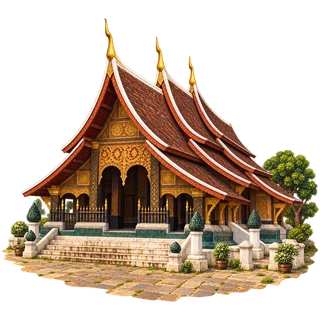
Wat Xieng Thong was founded under King Setthatirath around 1560. Its main sim has a low, sweeping three-tiered roof, a characteristic feature of Luang Prabang religious architecture. The temple stands above the Mekong near its meeting with the Nam Khan.