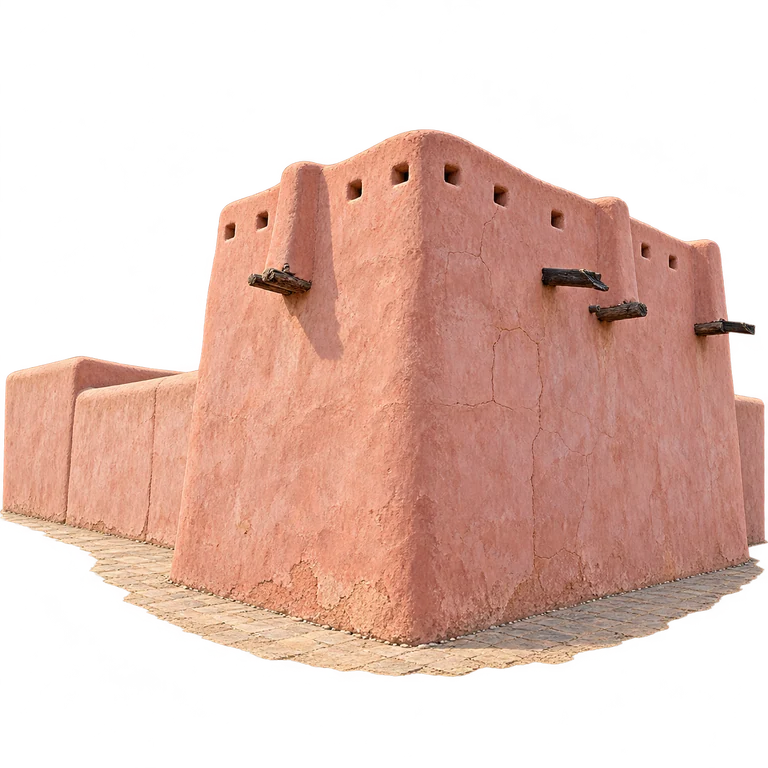
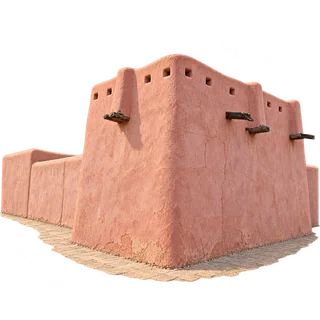
Jahra’s Red Palace, also known as the Red Fort, is a historic fortified building west of Kuwait City. Kuwait’s National Council for Culture, Arts and Letters includes it among the country’s museums. Its thick earthen walls and small high openings have a very different character from the glass towers of the modern capital. Present-day photographs show softly rounded parapet edges and dark timber ends projecting from the walls. Look for those details on the broad corner tower.
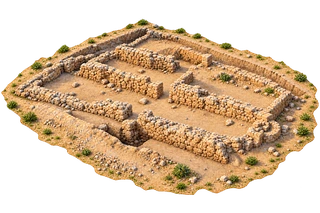
At Kharaib el-Desht on Failaka’s northwestern coast, a Kuwaiti-Polish archaeological mission investigated a fishing settlement. In its 2019 report, the team described a substantial building whose plan and niches suggest a mosque. Surviving foundations help archaeologists interpret the settlement’s activities and buildings.
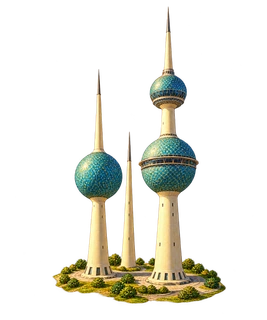
Beside the Arabian Gulf, three slender shafts carry a striking arrangement of mosaic-covered spheres. The tallest Kuwait Tower rises 187 metres and carries an upper viewing sphere. The neighbouring water-storage tower makes this landmark part of the city’s everyday infrastructure as well as its skyline. A third, narrower shaft completes the group. Their shared composition turns an engineering purpose into an unmistakable city symbol.
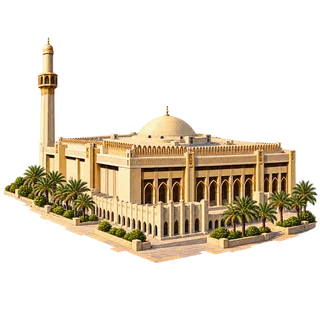
Kuwait’s Grand Mosque is a major place of worship in Kuwait City. Its exterior combines a broad low main building, a central dome and a tall minaret. Repeated arches and pale stone make the smaller details part of the larger rhythm of the facade. The government’s public services include guided visits arranged through the Ministry of Awqaf and Islamic Affairs. Look for the contrast between the mosque’s wide horizontal mass and the narrow vertical tower beside it.
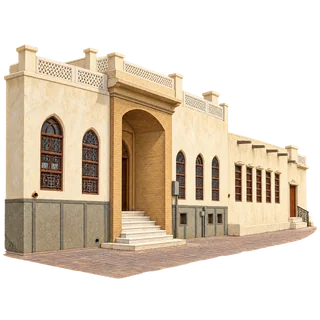
Sadu House preserves and shares the weaving traditions of Kuwait’s Bedouin communities. The house was built in 1936 and later became a home for the Al Sadu project. Its history brings together local building work and decorative influences from across the region, including timber doors brought from Karachi. The entrance frontage pairs a deep recessed arch with slender windows and a short flight of steps. Look for the texture of the brick arch before exploring the woven patterns celebrated inside.
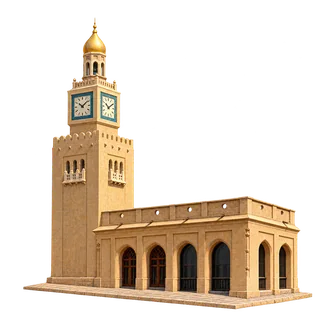
Seif Palace belongs to the historic civic landscape of Kuwait City. One of its best-known features is its clock tower, where blue tile surrounds pale clock faces beneath a golden roof. The narrow tower rises above the lower arcades beside it. This contrast makes the clock easy to pick out from the palace’s longer outline. Look from the simple sandy shaft to the open upper stage and the shining roof at its tip.