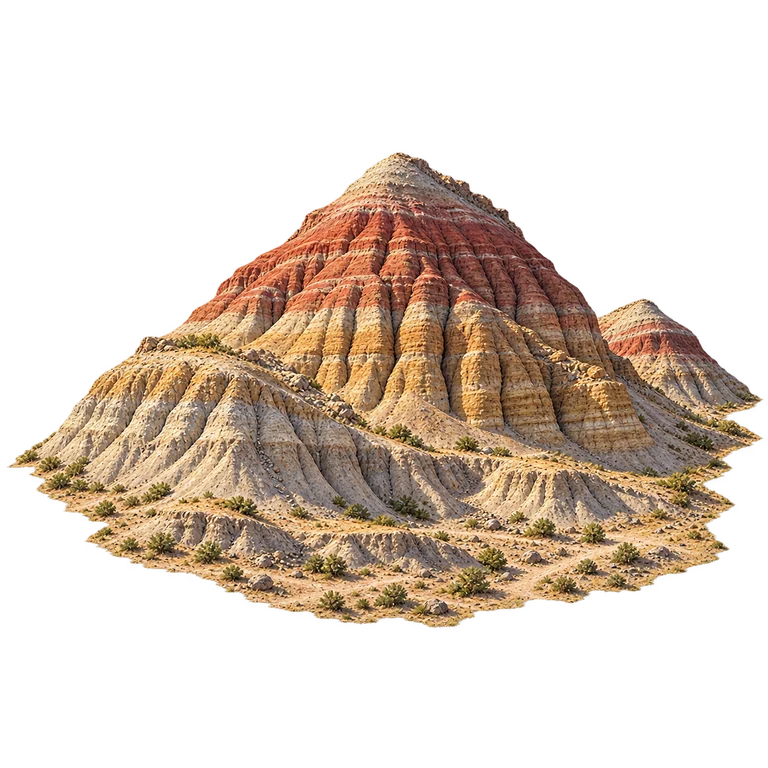
The Aktau Hills are one of the distinctive geological landscapes within Altyn-Emel National Park. Pale slopes, coloured bands and deeply cut flutes make their layered structure visible. From a distance the ridges can look almost architectural, yet their irregular gullies and connected shoulders belong to a natural landform. They are different from the darker Katutau formations elsewhere in the park. Reading their contrasts begins with colour, slope and the ways erosion exposes layers.
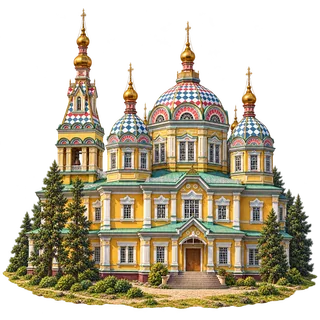
Ascension Cathedral was built in Almaty between 1904 and 1907. Its wooden construction survived the major earthquake of 1911, making the building an important part of the city’s architectural history. Pale trim and green roofs divide its lively exterior into clear layers, while domes and a bell tower form an uneven skyline. It remains an Orthodox place of worship.
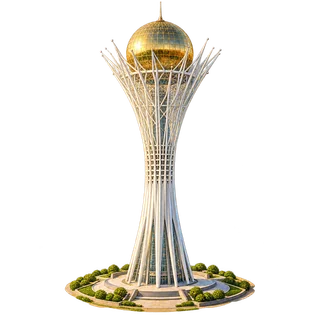
Baiterek gives architectural form to a story of the Tree of Life and the mythical bird Samruk. In that tradition, a golden egg represents the sun. The monument’s branching white supports cradle a mirrored sphere, turning the image into a conspicuous city landmark and observation tower. Its shape offers a way to read meaning through modern structure and materials.
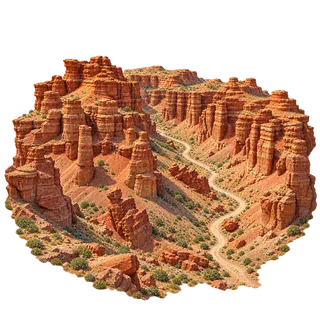
The Valley of Castles is a named part of Charyn’s canyon landscape. Uneven layers and weathering have left buttresses, narrow pillars and recesses that resemble built walls from a distance. The resemblance gives the valley its name, but the forms are natural rock. A path along the canyon floor lets the changing profiles become visible as one moves between them. The dry side valley is distinct from the Charyn River and its greener surroundings.
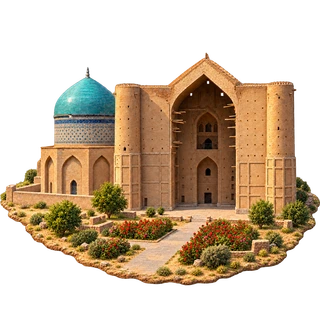
The mausoleum in present-day Turkestan was built under Timur between 1389 and 1405. Persian master builders developed structural and architectural solutions there that later influenced work in Samarkand. Parts remained unfinished, making the monument a record of both ambition and construction history.