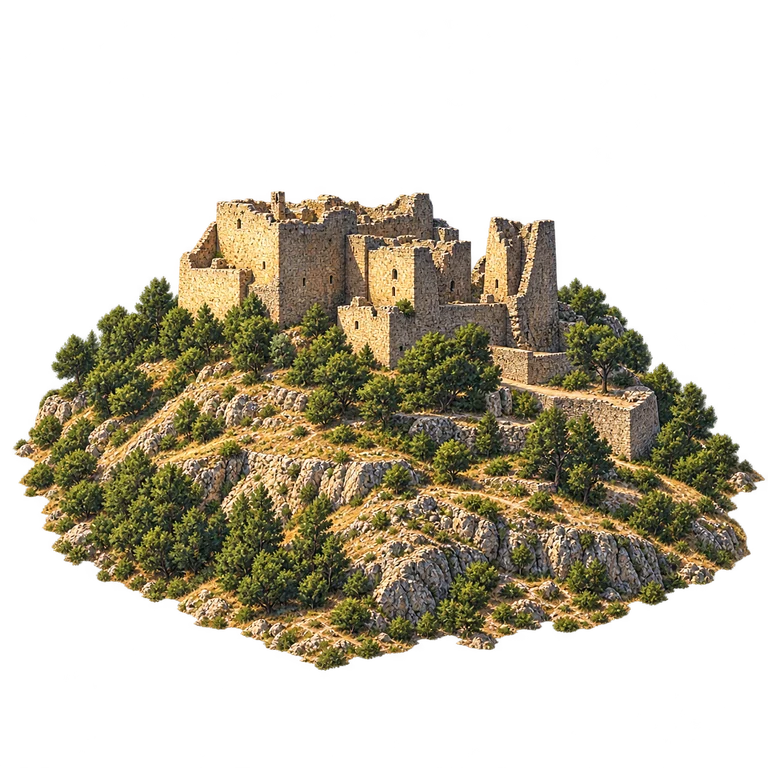
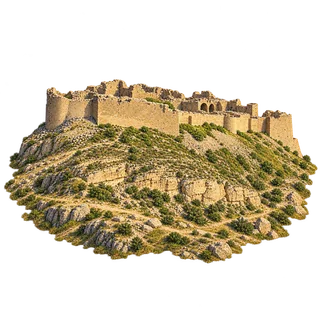
Ajloun Castle was built by the Ayyubids in the twelfth century to watch the valleys leading toward the Jordan Valley. Later Mamluk work expanded its defences and added architectural layers. Earthquakes and conflict also changed the building, leaving an irregular surviving mass rather than a single untouched medieval design. Its square towers, thick walls and hilltop setting reveal why the position mattered. The history belongs to changing communities and governments as well as military power.
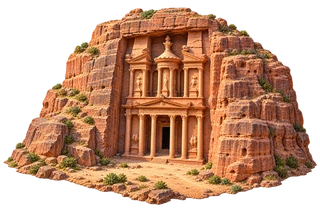
Petra’s Treasury, Al-Khazneh, is carved into a sandstone cliff. Its façade rises about 40 metres, with columns, broken pediments and a rounded upper centre crowned by an urn. Despite its familiar nickname, it is a façade tomb rather than a treasury of stored riches. Look at the way the architecture remains part of the rock around it: the cliff is both its material and its setting.
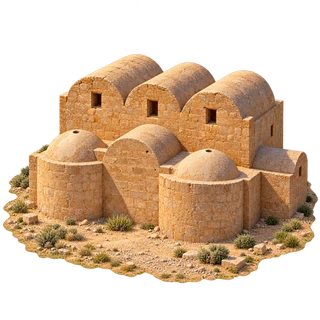
Quseir Amra was built in the early eighth century during the Umayyad period. Its surviving reception hall and hammam contain figurative wall paintings. These spaces preserve evidence of courtly life and secular artistic expression, within a small complex rather than a vast palace city.
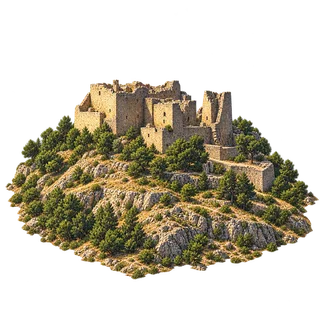
Shobak Castle began as a Crusader stronghold in the early twelfth century and was later changed under Ayyubid and Mamluk rule. Its surviving walls preserve that layered history. Long curtains, projecting towers and ruined interior spaces follow the hill rather than forming a neat modern square. Looking at the uneven skyline helps distinguish the remains from an imagined complete castle. Shobak’s history can be read through successive uses and repairs without recreating its battles.
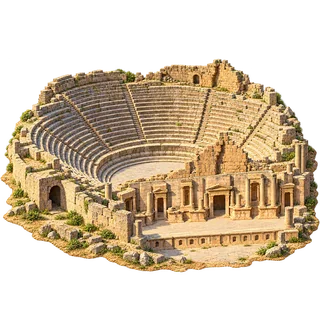
Built between about 80 and 96 CE, the South Theatre could accommodate more than three thousand spectators. Its curved seating and decorated stage made a place for performance within Roman Gerasa, the ancient city at Jerash. The surviving stonework also carries later repair and conservation. Performance is not entirely confined to the past here: the theatre continues to host music during the Jerash Festival. Its open bowl connects an ancient civic building with a continuing cultural life.
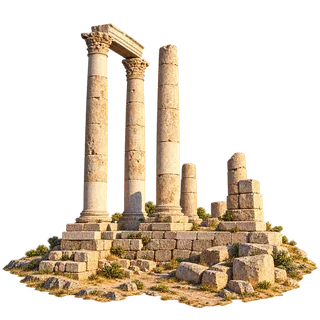
The Temple of Hercules stands on Amman’s Citadel hill among remains from several periods of the city’s history. The Roman temple belongs to the second century CE. Today, tall columns and fragments suggest a building far larger than the surviving group. A short beam still spans two columns, while other shafts end abruptly. Those gaps are part of the experience of the place: they distinguish what survives from what must be understood through archaeology.