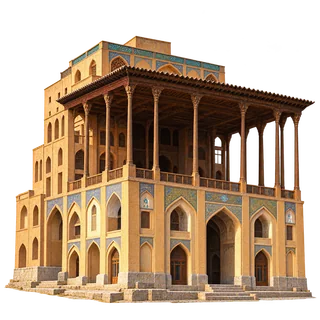
Ali Qapu stands on the western side of Naqsh-e Jahan Square in Isfahan. This Safavid palace served royal meetings and receptions. Its raised columned porch offered a view across the square, where polo was played. Look for the slender timber columns above the heavier arched lower frontage.
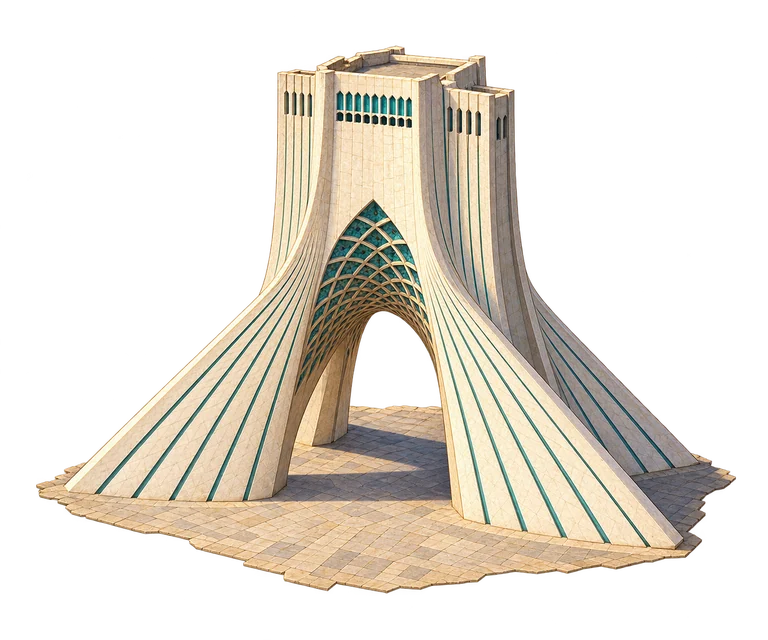
Azadi Tower brings together modern design and references to Iran's architectural past. Hossein Amanat designed the monument, whose pale surfaces sweep upward into a soaring arch. Look beneath that opening: geometric ribs turn the underside into a patterned ceiling. The tower stands in Azadi Square on Tehran's western side, giving a very busy urban entrance a distinctive silhouette.
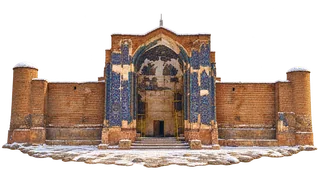
Look for the ultramarine tiles against the exposed brick. The Blue Mosque was part of the Mozaffarieh complex under the Qara Quyunlu rulers. Earthquake damage and later repairs have left a striking contrast between surviving mosaics and plainer surfaces.
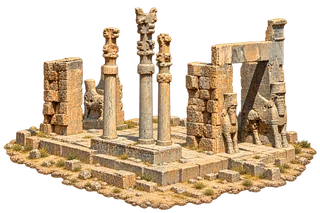
At Persepolis, monumental gateways introduced visitors to a vast royal complex. The Gate of All Nations survives as weathered doorway blocks, guardian figures and slender columns. Walk your eyes from the heavy stone piers to the elaborate capitals above: strength and fine carving work together. These ruins belong to an Achaemenid centre built on an immense terrace, where royal ceremonies and receptions brought many people together.
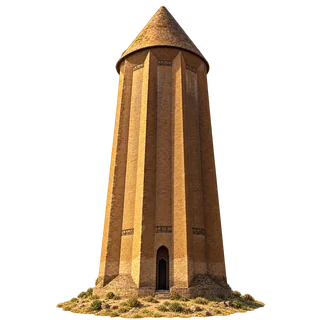
Gonbad-e Qabus is an early Islamic tomb tower in northeastern Iran. Its unglazed brick shaft rises from a geometric plan with ten projecting flanges. A conical roof caps the tower, while two bands of brick inscriptions mark its sides. The monument was built in 1006 for the ruler Qabus Ibn Voshmgir.
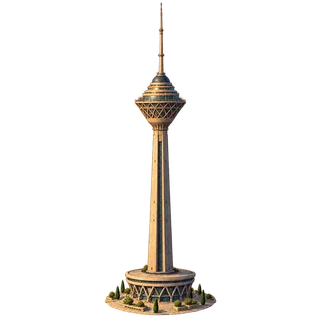
Milad Tower is a modern landmark of Tehran. Its communications functions include radio, television and wireless coverage. Above the slender shaft, a broad tower head holds viewing and visitor spaces beneath the antenna. Look for the contrast between the narrow vertical body and the basket-like structure near the top.
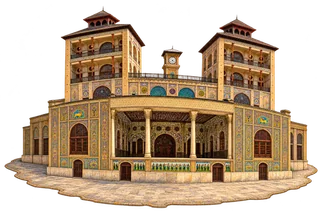
Start with the open balconies, then trace the colourful tilework down to the columned veranda. Shams-ol-Emareh belongs to Tehran’s Golestan Palace, where Qajar-era builders combined Persian craftsmanship with ideas from beyond Iran.
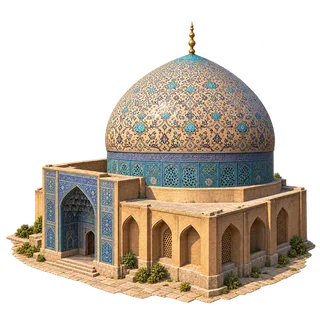
Sheikh Lotfollah Mosque faces Naqsh-e Jahan Square in Isfahan. Built during the Safavid period, it is especially known for its tiled dome. Unlike many mosques, it has no minarets. Compare the warm brickwork with the blue tilework around the entrance and beneath the dome.
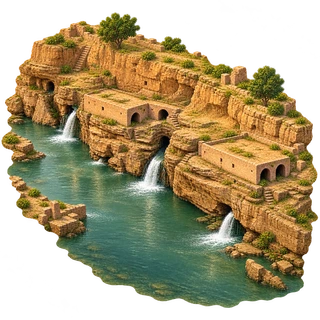
Engineers at Shushtar redirected water from the Karun through canals and tunnels. Water fed mills and supplied the city, before reaching agricultural land downstream. Dams, bridges, measuring structures and basins formed parts of a coordinated system, showing how one river could serve many purposes.
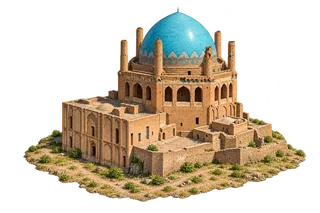
The Mausoleum of Oljaytu is the great surviving landmark of Soltaniyeh, once an Ilkhanid capital. Built in the early fourteenth century, it combines an octagonal body with a remarkable double-shell dome. Turquoise tiles lift the curved roof above warm brick galleries and slender minarets. Its structure became an important reference in the development of later Islamic domes.
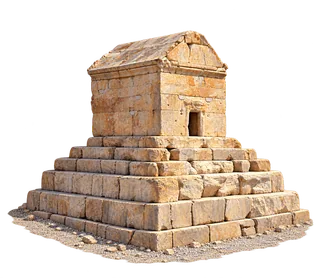
The Tomb of Cyrus is a compact limestone monument with an unusually clear outline. A small chamber rests on a receding stepped base, its plain gabled roof standing apart from the surrounding archaeological remains. It belongs to Pasargadae, the first dynastic capital of the Achaemenid Empire, founded by Cyrus in the sixth century BCE. The monument invites a slower look at how simple forms can make a lasting impression.