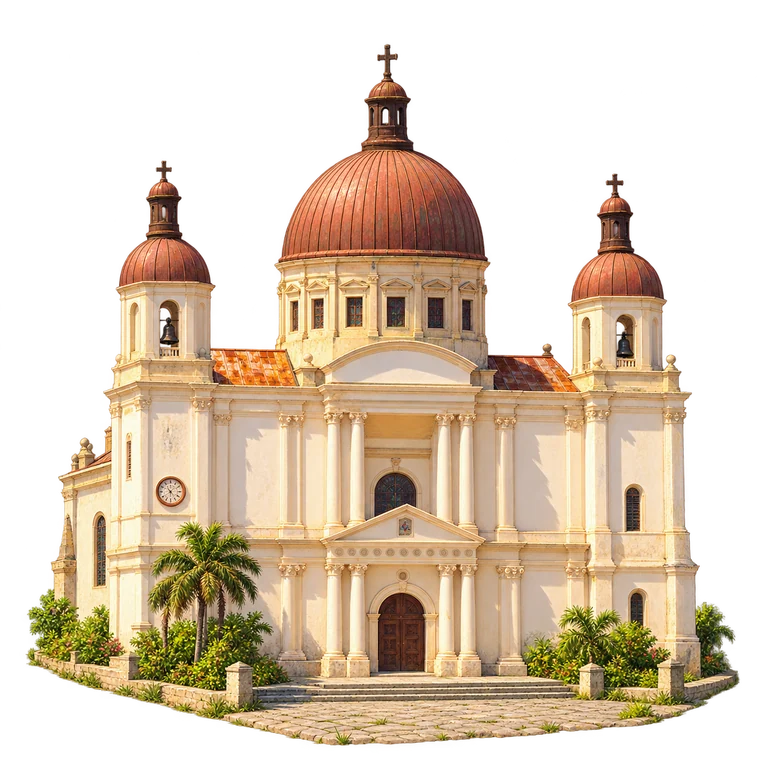
Notre-Dame-de-l’Assomption Cathedral anchors Place d’Armes in Cap-Haïtien. Local accounts describe a building shaped by repeated restoration across the city’s history. Its pale frontage, large central dome and two smaller domed towers make a distinctive composition. Look for the entrance pediment beneath the larger dome, then compare the three roof forms. This is the cathedral of Cap-Haïtien, a different building from the ruined cathedral in Port-au-Prince.
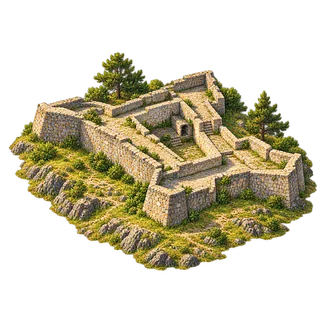
Fort Jacques belongs to the network of defences associated with Haiti’s early independence. In the hills near Kenscoff, its low stone walls enclose an open interior rather than the great towered mass of the Citadelle. Look for the projecting corners, the rough masonry and the short steps connecting different levels. The surviving fort’s compact enclosure offers another way to notice how architecture was adapted to defence in the newly independent country.
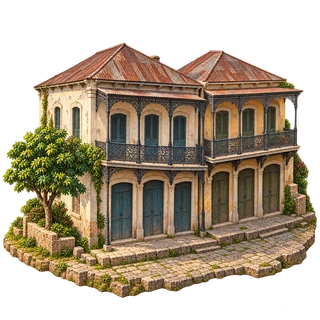
Jacmel's historic centre developed around a port in southern Haiti. After a major fire in 1895, rebuilding retained the earlier street plan and introduced prefabricated building elements imported from Europe. Wood, masonry and worked iron balconies together created a distinctive townscape, with trading spaces below and living accommodation above.
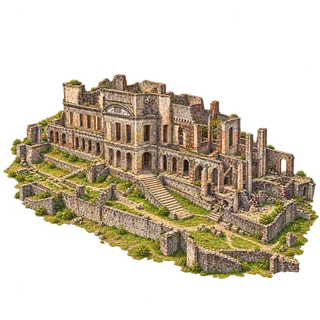
Sans-Souci Palace stands near Milot, below the route towards the Citadelle. Henri Christophe’s royal residence formed part of a much larger administrative ensemble after Haitian independence. UNESCO records its inauguration in 1813 and the severe damage caused by the 1842 earthquake. The surviving walls, arches and terraces still reveal the palace’s scale. Look for the broad staircase rising towards empty windows: this is a ruin, with the lost roofs left open to the air.
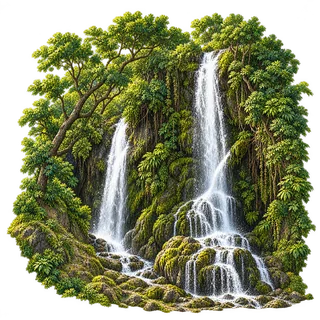
Saut-d’Eau is a waterfall site with deep significance for Haitian Catholic and Vodou pilgrims. Local photo reportage shows water falling through lush vegetation onto rounded rocks. United Nations reporting has also described efforts to protect the springs feeding the falls. Look for the taller stream and the lower cascade beside it, then the small channels slipping over mossy boulders. The living religious traditions belong to the place’s cultural history; this scene concentrates on the water and forest.