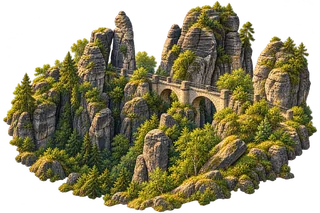
The Bastei Bridge belongs to Saxon Switzerland's dramatic rock landscape above the Elbe valley. The present stone bridge dates from 1851. Rather than dominating the scene like a great road viaduct, its arches join the much larger sandstone formations.
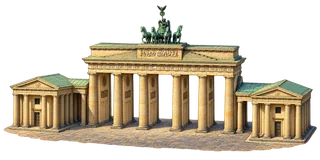
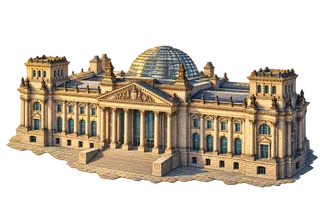
Look through the five passages between the gate's six central columns, then up to the Quadriga. The gate was completed in 1791, with the chariot sculpture added in 1793. Its restrained classical form is very different from a medieval city gate.
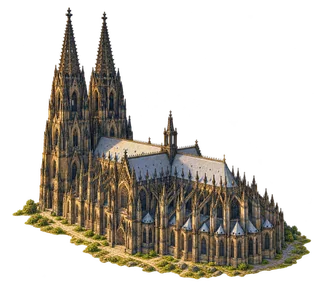
The twin western towers make the cathedral's silhouette instantly recognisable. Behind them, the long roof, transept and buttressed eastern choir reveal a much larger building than the entrance facade alone suggests. Look for the contrast between dense stone supports and delicate openwork high above.
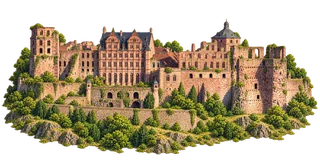
Heidelberg Castle combines buildings from different periods. War, fire and later preservation left a mixture of roofless walls and restored architecture. The Friedrich wing stands out with its ornate paired gables, while empty windows and broken fortifications reveal the ruin around it.
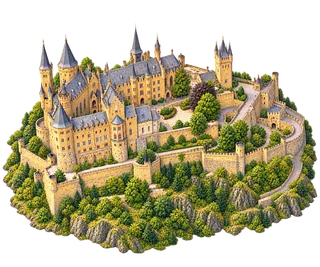
The present Hohenzollern Castle is the third castle on this site. Begun in 1850 and inaugurated in 1867, its neo-Gothic buildings frame a courtyard within older fortified ground. The approach ramp and lower bastions help explain the layered silhouette.
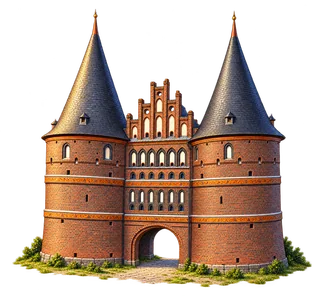
Built between 1464 and 1478, the Holstentor served both defence and civic display. Its round towers, conical roofs and stepped central gable make a compact silhouette quite unlike Berlin's classical gate. Brick decoration gives the heavy walls a finer rhythm.
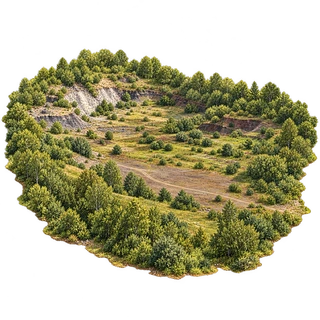
Messel Pit in Hesse preserves an exceptional record of Eocene plants and animals. Some fossils retain details far beyond isolated bones, including articulated skeletons and evidence of soft tissues or stomach contents. Those traces allow researchers to investigate animals and the environments they inhabited.
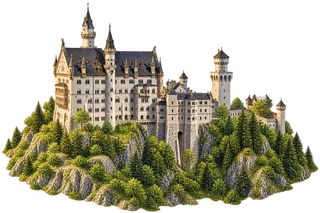
Neuschwanstein was built for King Ludwig II in the nineteenth century. Its castle-like appearance combines modern construction for its time with an imagined historic atmosphere: the walls use brick behind light-coloured limestone cladding. The long main palace and varied towers form an asymmetric composition.
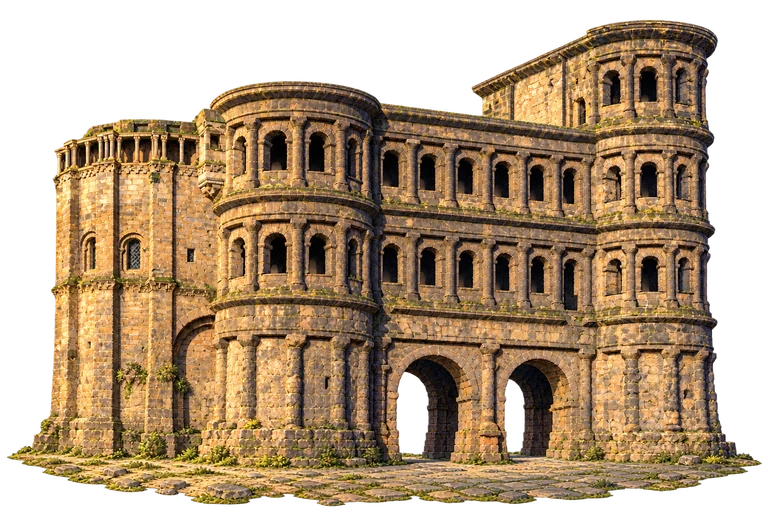
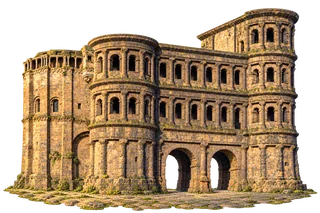
Built around AD 170, Porta Nigra survives through layers of later use as well as its original Roman structure. Rounded towers, heavy sandstone blocks and galleries of arched openings give it a distinctive silhouette. The adjoining rounded wall mass is retained from the photographed exterior rather than replaced by an invented matching tower.
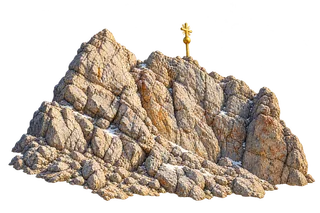
At 2,962 metres, Zugspitze is Germany's highest mountain. Its golden summit cross is a familiar feature, set against rough pale rock rather than an invented needle-shaped peak. The miniature focuses on the immediate summit rock and cross, not the whole mountain massif.