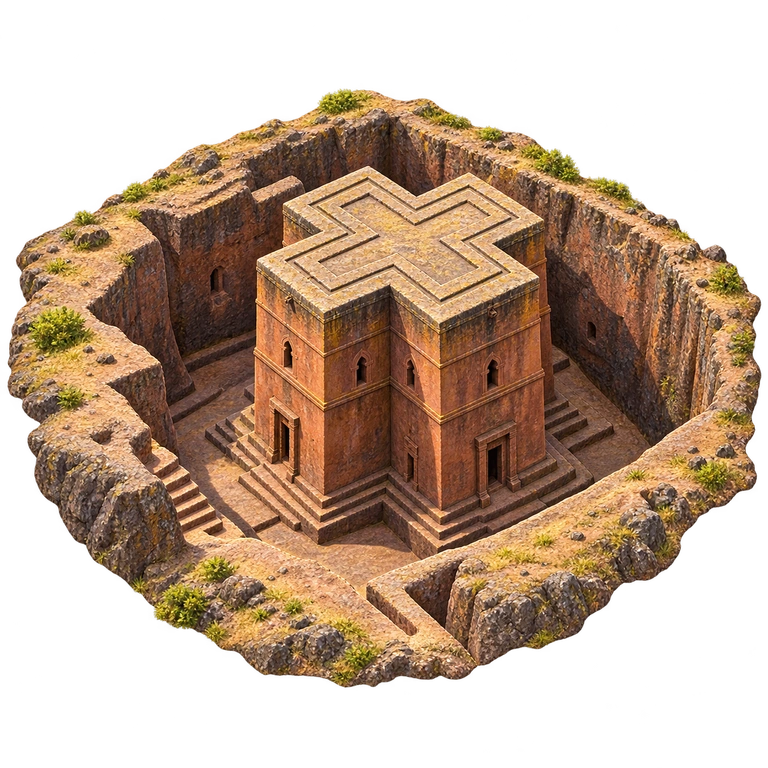
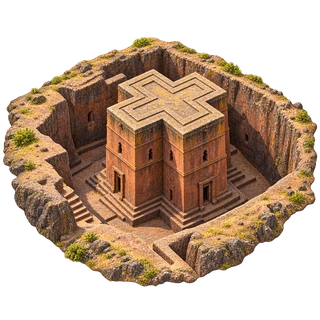
At Saint George’s church, the roof reveals the cross-shaped plan before you reach the doors below. Medieval craftspeople cut away the surrounding rock, leaving a monolithic church with walls, windows and a stepped base. It stands apart from Lalibela’s other rock-hewn churches, linked to them by trenches. This remarkable place is also part of a living religious landscape.
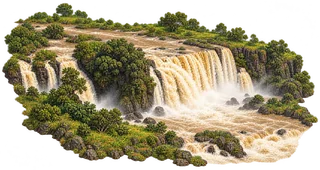
Known locally as Tis Isat, the Blue Nile Falls lie on the Blue Nile near Bahir Dar. Water drops over an irregular cliff roughly 45 metres high before collecting in the gorge below. The national tourism description highlights the spray during the rainy season.
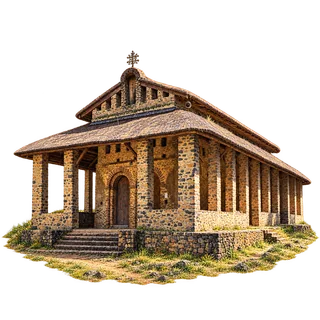
Debre Berhan Selassie stands in Gondar. Its stone walls and broad thatched veranda give little hint of the rich painted interior for which the church is known. Timber, stone and deep shade make a different introduction to the building.
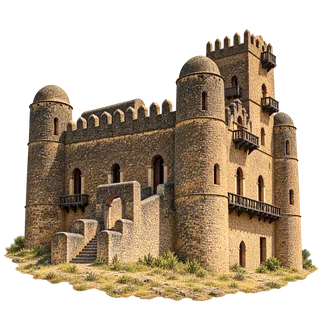
Fasilides’ Castle is one of the principal palaces inside Fasil Ghebbi, Gondar’s royal enclosure. The seventeenth-century royal city brought palaces, churches and other buildings together. Here the compact castle’s towers, stairs and deep openings take centre stage.
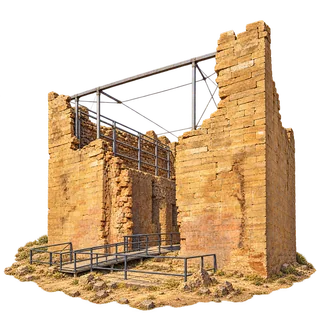
The Great Temple of Yeha preserves unusually tall walls of finely cut stone. Fire and long weathering damaged the ancient building, and conservation work helps stabilise its surviving shell. The open ruin lets the masonry itself tell the story.
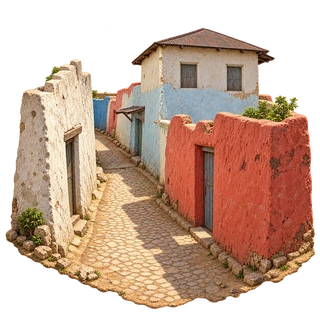
In eastern Ethiopia, Harar Jugol's walls enclose mosques, shrines and distinctive townhouses. African and Islamic traditions helped shape its buildings and street plan. The interiors of traditional Harari houses are an especially significant part of this urban heritage, which remains connected to the community living there.