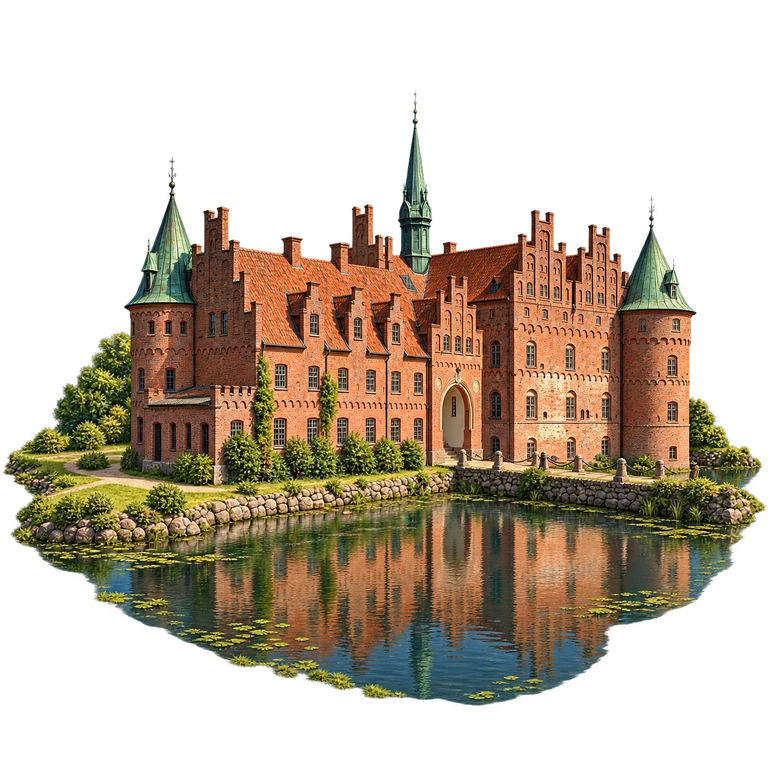
Egeskov was completed in 1554 for Frands Brockenhuus. Its attractive brickwork also belonged to a defensive design: water surrounded the building, making it harder to approach during a politically unsettled period. The paired house blocks, steep gables and round corner towers bring together late medieval and Renaissance forms. The painting concentrates on this present castle and its immediate moat edge. The wider gardens and visitor estate have their own history beyond this small architectural scene.
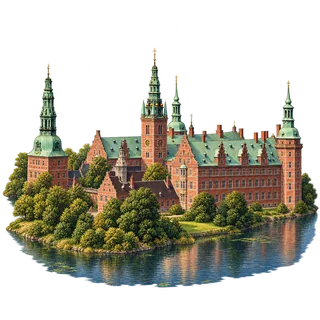
Christian IV transformed Frederiksborg into a Renaissance palace in the early seventeenth century. Its towers and linked wings make an elaborate skyline above a lake. A devastating fire in 1859 damaged much of the interior, but the castle was rebuilt; the chapel and audience chamber were among the spaces that survived. Today the National History Museum adds another chapter to the building’s story. The miniature follows the present palace group, rather than reconstructing rooms lost in the fire.
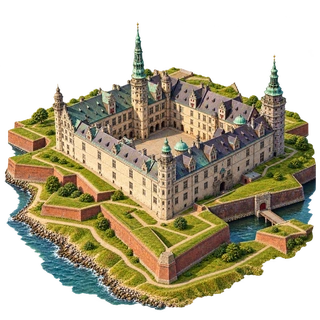
Work on Kronborg at Helsingør began in 1574. Its strategic position commands the Øresund, and later seventeenth-century works strengthened its defences. The castle is also associated with Elsinore, the setting of Shakespeare's Hamlet, giving this coastal monument both military and literary significance.
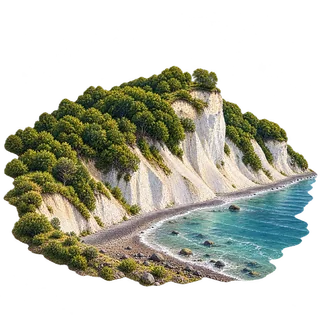
The chalk of Møns Klint began as tiny marine organisms on an ancient seabed around seventy million years ago. Much later, ice reshaped and pushed up the material that is exposed in today’s cliffs. Dark woodland above, pale fractured faces and shingle below reveal different parts of that history in one view. The miniature represents a connected stretch of this changing chalk coast. It does not identify every individual pinnacle or promise that an unstable cliff edge stays unchanged.
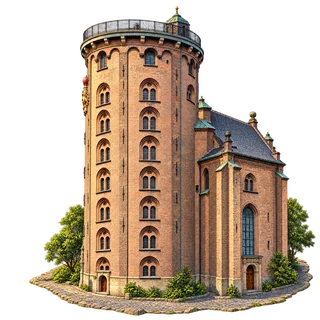
Rundetaarn was completed in 1642 as part of Christian IV’s Trinity complex. Observation, learning and worship were gathered together: the tower held an observatory, the adjoining complex included a university library and Trinity Church. A broad spiral ramp winds up inside the tower instead of a conventional staircase for most of the ascent. Outside, its cylindrical brick body and repeated arched windows make a distinctive silhouette. This scene concentrates on the tower with only a small adjoining church fragment.