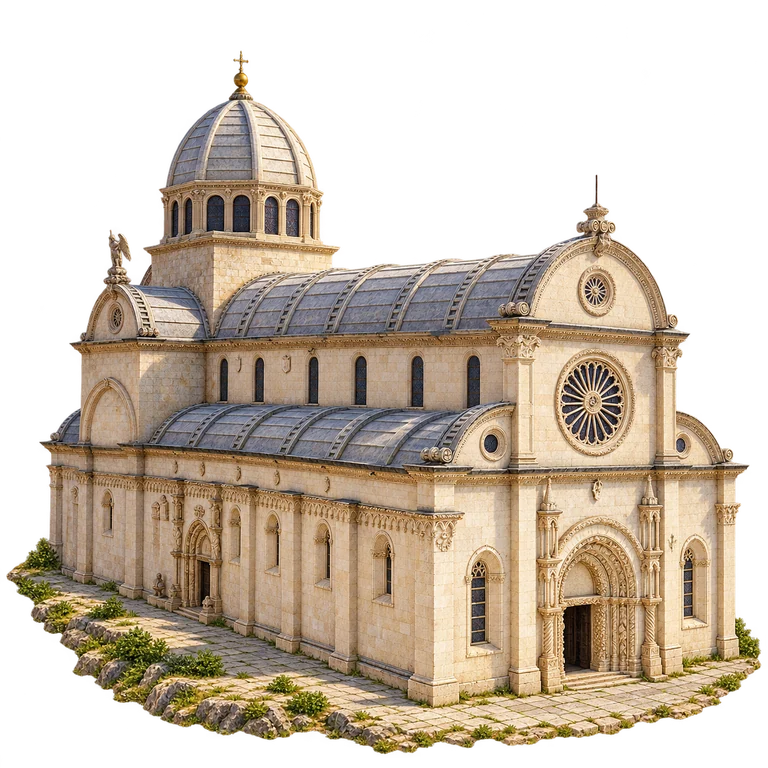
The Cathedral of St James was built between 1431 and 1535 through an exchange of architectural ideas around the Adriatic. Its Gothic and Renaissance features belong to a building constructed entirely of stone. The unusual stone roof and dome are part of that achievement, rather than a thin decorative cover hiding an ordinary tiled church. The miniature follows the long barrel-vaulted body, curved western facade and single crossing dome. Fine carved heads and sculptural details remain a painter’s interpretation.
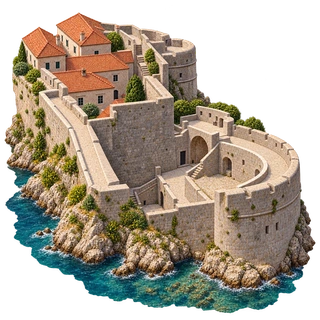
Dubrovnik became an important Mediterranean maritime power from the thirteenth century. Its old city contains Gothic, Renaissance and Baroque churches, palaces, monasteries and fountains. An earthquake in 1667 caused severe damage, while later survival and repair made the historic ensemble a record of both prosperity and disruption.
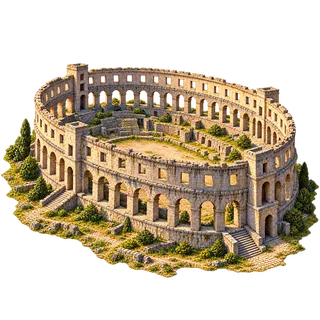
Pula’s amphitheatre was built in the first century CE, when the city formed part of the Roman world. Its outer oval measures about 132.5 by 105.1 metres. Because it stands on sloping ground, the wall’s visible height changes around the circuit. Four rectangular towers held stairways, while the open interior preserves only part of the former seating and supporting spaces. The building also recalls violent public spectacles. The miniature shows surviving architecture, without recreating those events or restoring an imaginary complete Roman auditorium.
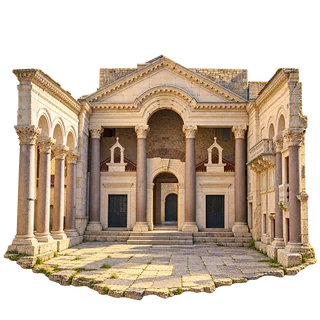
The Peristyle was the central court of Diocletian’s palace, where architecture helped stage the emperor’s authority. At its southern end, the Prothyron entrance gives a semicircular arch a place within the horizontal entablature beneath a triangular pediment. Later buildings and uses became part of the surviving court instead of leaving an untouched imperial scene. The miniature concentrates on that southern entrance and short colonnade returns. It does not reconstruct the whole palace or invent a Roman ceremony.
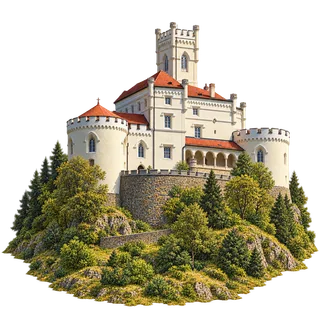
Trakošćan’s origins are traced to a small medieval fortress, probably built in the thirteenth century. The Drašković family’s long association with the site began in the sixteenth century. A major nineteenth-century transformation gave the residence much of its present Romantic historicist character. Its pale walls and crenellated towers therefore tell several periods of history at once. This scene follows the current main castle on its knoll, leaving the wider lake and landscaped estate outside the painting.