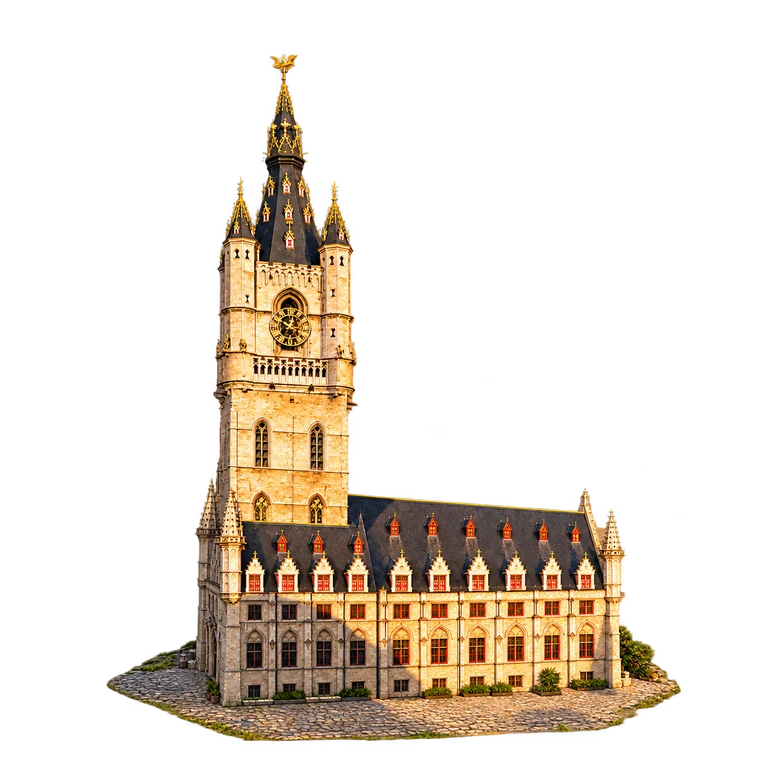
Ghent’s belfry rises between the city’s other great towers. It was a symbol of civic independence, a place associated with city privileges and a lookout for danger. The adjoining Cloth Hall connects the tower with trade, while the dragon above it gives the skyline a distinctive finish.
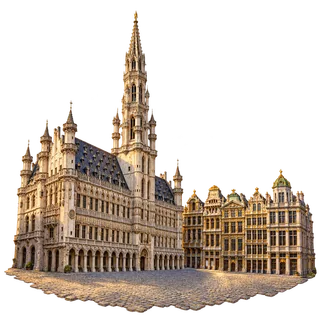
Brussels’ Grand-Place brings the town hall and richly decorated guild buildings into a single urban space. Much of the ensemble reflects rebuilding after the bombardment of 1695, while the town hall preserves an older Gothic presence. The square shows how trade, government and rebuilding shaped the city.
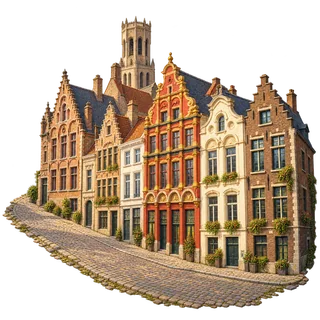
Brugge preserves a historic urban fabric associated with medieval commerce and later cultural life. Gothic buildings, streets and waterways form a connected townscape. Its history also includes the artistic world of the Flemish Primitives, linking the city’s trading prosperity with an influential painting tradition.
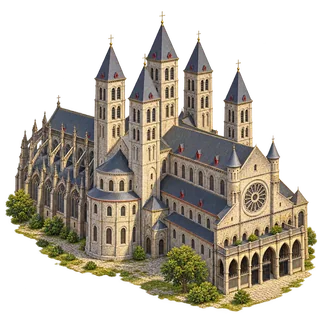
Tournai’s cathedral combines a Romanesque nave and transept with a later Gothic choir. Its five-towered profile makes the building especially recognisable. Looking at the different parts together shows how a major church could grow through changing approaches to space, structure and ornament.
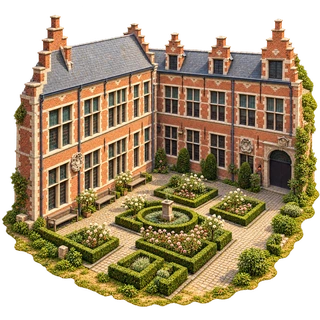
The Plantin-Moretus complex in Antwerp combines a historic home, printing workshops and publishing records. Associated with Christophe Plantin and his successors, it preserves equipment, books, archives and art. The ensemble reveals how a major early modern printing business worked within its architectural setting.