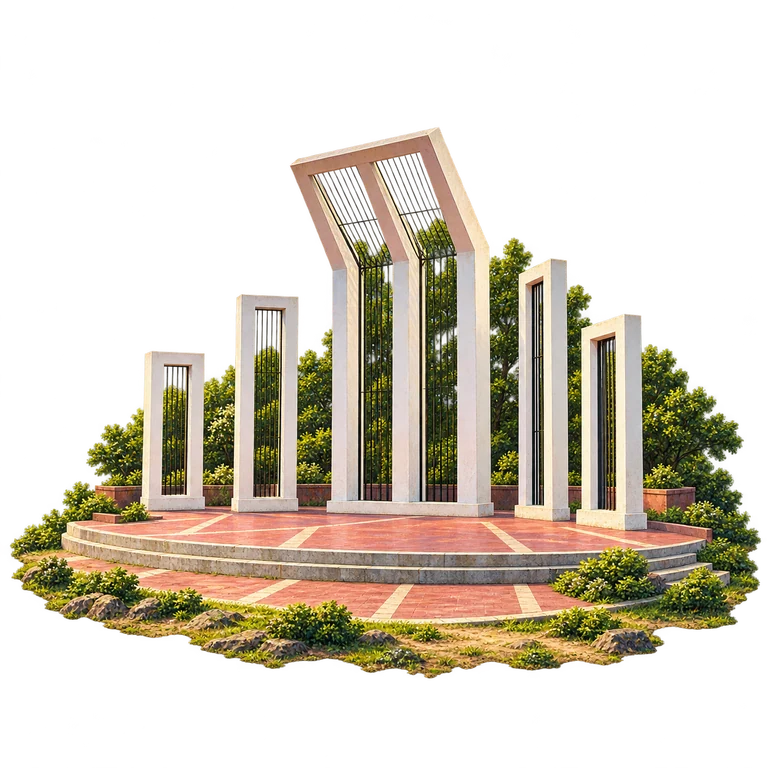
Central Shaheed Minar commemorates people killed during the Bengali Language Movement demonstrations of 1952. Hamidur Rahman worked with Novera Ahmed on the monument’s design. Completed in 1963, it was destroyed during the 1971 war and later rebuilt and expanded. The rising white frames create a place of remembrance without enclosing it. Commemorations on 21 February connect the site with language, cultural identity and the right to speak one’s mother tongue.
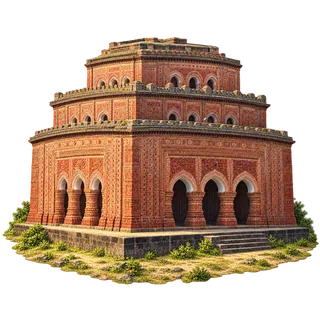
Kantajew Temple is an eighteenth-century Hindu temple at Kantanagar, known for its richly worked terracotta walls. Its arches and smaller upper stages once supported nine spires. Those spires were lost in the earthquake of 1897, leaving the lower, stepped silhouette visible today. Looking at the surviving surfaces reveals another kind of richness: patterned clay panels turn walls and columns into a close field of ornament. The temple belongs to a living religious tradition as well as an architectural history.
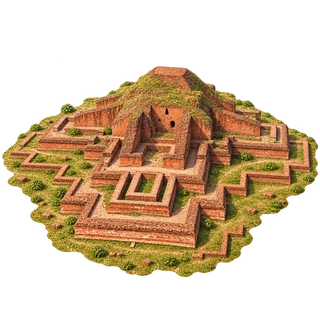
Somapura Mahavihara at Paharpur was an important Buddhist intellectual centre in Bengal. Its organised monastic layout and carved decoration influenced religious architecture elsewhere in the region. The surviving ruins show how a large religious community arranged spaces around its central monument.
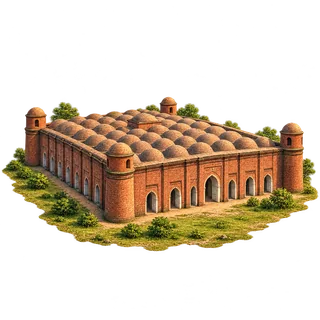
Sixty Dome Mosque is a major monument of the Historic Mosque City of Bagerhat. The city developed under Khan Jahan in the fifteenth century, with mosques, roads, reservoirs and other works built largely in brick. Here, a low rectangular hall and rounded corner towers give the building a broad, grounded shape. Repeated domes turn its roof into a field of small curves. The monument also belongs to a religious landscape whose buildings continue to be used and cared for.
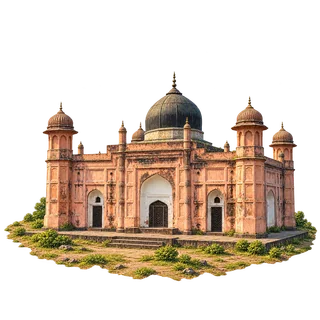
The tomb of Bibi Pari stands among the principal buildings of Dhaka’s unfinished Lalbagh Fort. Bibi Pari, also known as Iran Dukht, was the daughter of Shaista Khan and died in 1684. Her tomb lies between the Diwan-i-Aam to the east and the mosque to the west. This arrangement places a memorial within a larger administrative and religious complex. Its low square body, raised central portal and domed corners make it distinct from the surrounding fortifications.