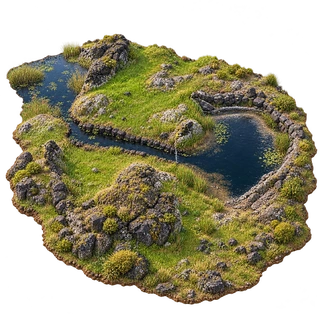
Gunditjmara people shaped the wetlands around Budj Bim into connected channels, weirs and dams. These structures redirected water and helped trap, hold and harvest kooyang, the short-finned eel. The landscape preserves engineering developed over millennia, together with continuing knowledge and cultural practices passed between generations.
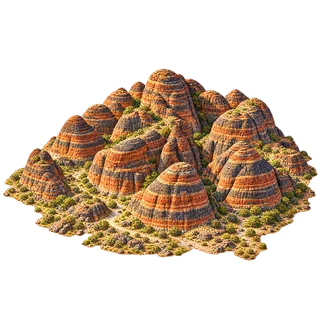
The Bungle Bungle Range is famous for its beehive-shaped sandstone. Dark surface bands contrast with warmer orange layers, making the domes easy to recognise. Gullies and gorges divide the formations into a landscape worth looking at slowly.
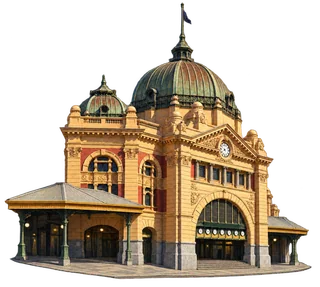
At Flinders and Swanston streets, the yellow station facade curves around its domed entrance pavilion. Completed in 1910, Flinders Street Station became a familiar meeting place beneath the clocks.
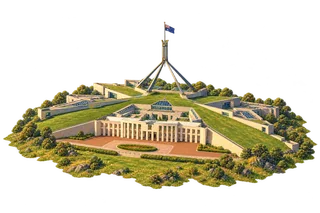
The building sits within Capital Hill rather than simply on top of it. Low roof forms meet the landscaped slopes, while the four-legged steel mast marks the centre. From the front, the entrance and broad wings lead the eye back towards that high flag.
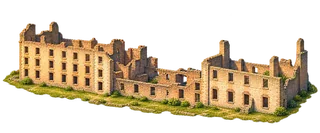
This long building began as a flour mill and granary before conversion into a penitentiary in the 1850s. After the settlement closed, an 1897 fire left a roofless ruin. Look along the open windows and surviving wall heights rather than imagining a restored roof.
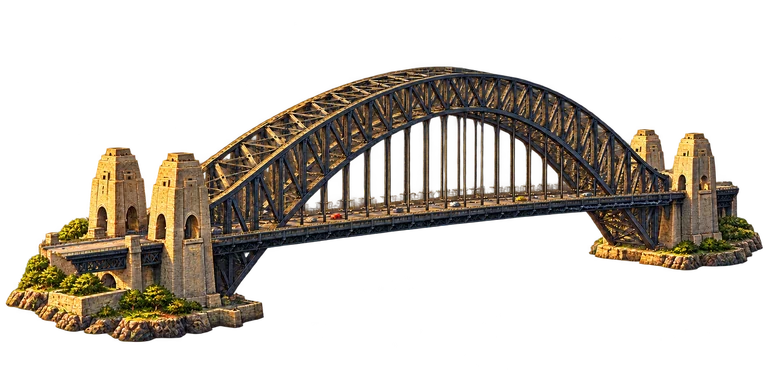
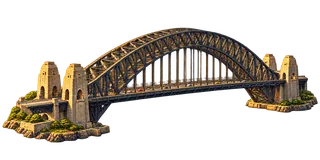
Sydney Harbour Bridge opened in 1932, linking the northern and southern sides of the harbour. Its broad steel arch carries the roadway through a lattice of girders and vertical hangers. Look for the four pale granite-faced pylons, arranged in pairs at the ends. Below the span lies the harbour itself. The crossing is a landmark of transport engineering as well as a familiar part of Sydney’s skyline.
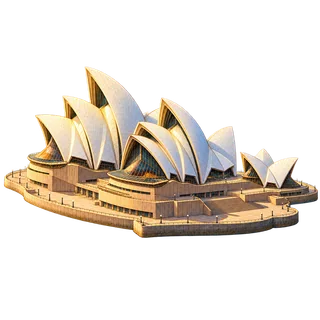
Sydney Opera House opened in 1973 on Bennelong Point. Danish architect Jørn Utzon designed its remarkable roof forms, whose geometry was developed from sections of a sphere. The rising shells have become a familiar symbol of Sydney Harbour. Beneath them is a working performing arts centre, hosting many forms of music and performance. The site is also Tubowgule, a place with a much older history of Aboriginal gathering and ceremony. Looking at the building means considering both its ambitious modern architecture and the harbour setting around it.
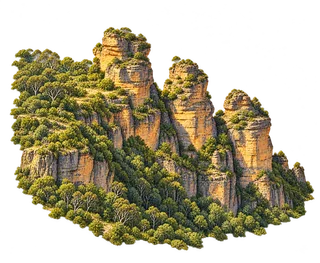
Near Katoomba, the Three Sisters stand out from the Blue Mountains' forested cliffs. Their separate sandstone summits form a recognisable group against the valley. This account follows the landscape itself without inventing or retelling a cultural legend.
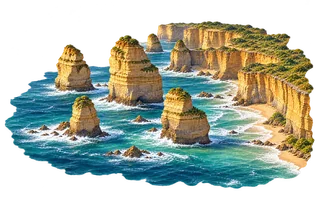
The stacks belong to the sea-and-cliff landscape of the Great Ocean Road. Look between the isolated rock towers and the mainland cliff: the gaps and breaking surf make the coastal setting easy to recognise.
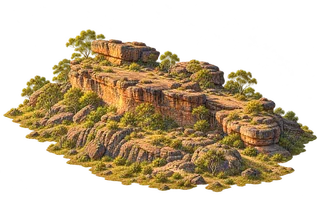
At Ubirr, the public walk climbs from the sandstone country towards a lookout across the Nadab floodplain. The rock terraces and wide landscape provide the subject here. No rock-art panels, motifs or cultural stories have been reproduced or invented.
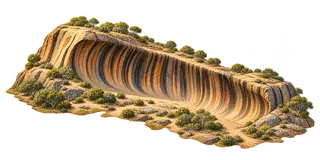
Wave Rock’s sweeping curve is stone rather than surf. Weathering has shaped the granite near Hyden, while streaks mark the rock face. The long concave wall makes a striking change from the surrounding low country.
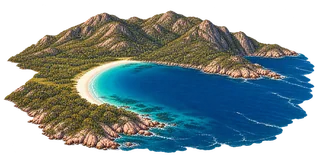
From the lookout, Wineglass Bay is recognised by its curved beach, clear water and forested granite landscape. The bay remains open to the sea. Follow the white sand around the curve and into the connected headland rather than reading it as an enclosed island lake.